If you work in tech, you’ve likely heard the term “vibe coding.” It describes a shift in how engineers work with AI. Instead of starting with syntax, they begin with intent, constraints, and outcomes. AI handles execution, and humans review and refine.

What Vibe Coding Teaches Us About Executive Communication: Get to Decisions Quicker
Intent First, AI Second
That same shift applies to communication and presentations. AI has transformed how presentations are built. The tools are faster, smarter, and more capable. However, as AI reshapes how work is produced, vibe coding makes one truth unavoidable. The leaders who stand out will be those who treat communication the way vibe coders treat software: clear intent first and human refinement always. Technology can accelerate execution, but authentic leadership grounded in human clarity, judgment, and context is what creates resonance.
AI has commoditized production; leadership advantage now lies in framing the right decision and refining the message that drives it.
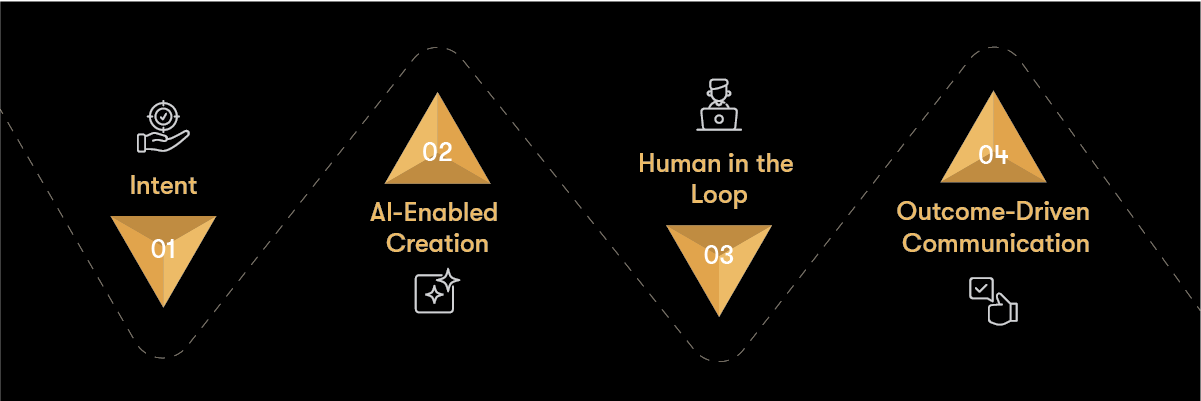
Begin with Clear Intent & Outcomes
Vibe coding works because effort moves upstream. Engineers define what they want before execution begins. When intent is clear, output improves. When it isn’t, work may look polished but the work may miss the mark.
Executive communication follows the same pattern. Leaders provide direction so teams can act with clarity and confidence. When direction is vague or misaligned, even the best-looking materials fall flat. This is especially important for leaders. Effective leaders understand not only what executives want to know, but how they process information, including priorities, risks, and decision criteria. Clear communications and visual guides are critical to impactful outcomes.
Communications Guidelines
Formal slide presentations & reports remain one of the primary vehicles for executive communication. They communicate progress, risks, trade-offs, and next steps, and they often determine outcomes. Including but not limited to:
- Securing budget or headcount
- Triggering leadership intervention
- Aligning stakeholders
- Demonstrating impact
- Supporting go or no-go decisions
In these moments, the presentation is the mechanism through which decisions are made. How information is structured directly influences the result. Clear, consistent presentations help leaders quickly understand what’s happening and what decisions are required. That clarity enables action.
Visual Guidelines
When narratives are unclear or visuals are inconsistent, attention shifts away from the decision. Questions multiply. Meetings drag. Momentum slows. Clear visuals reduce friction by keeping leaders focused on substance rather than interpretation. Effective presentations are supported by:
- Clear brand guidelines
- Fonts that reinforce tone and readability
- Color systems that establish hierarchy
- A consistent visual language, including layout, spacing, iconography, and imagery
- Thoughtful engagement elements when appropriate
When visual standards are embedded into templates and tools, teams spend less time formatting and more time shaping messages that resonate and drive decisions. With these strong principles as a start, you are now ready to leverage your AI-powered tools.
AI-Powered Tools that Accelerate Outcomes
AI powered tools like Microsoft PowerPoint with Copilot, Canva, Gamma, Beautiful.ai, and Tome make it easier than ever to produce polished decks quickly. They handle layout and design so teams can focus on content.
| Tool | What They’re Good At | How They Accelerate Executive Briefs |
|---|---|---|
| Microsoft PowerPoint with Copilot | Turning existing documents and notes into structured presentations inside PowerPoint | Converts raw information into formatted, executive-ready slides directly within the PPT environment |
| ChatGPT | Structuring narratives, summarizing complex information, drafting slide outlines and speaker notes | Speeds up the creation of decision-ready content before it moves into presentation tools for final design |
| Canva | Enforcing brand consistency through templates and brand kits | Keeps presentations visually aligned while reducing time spent on formatting and layout decisions |
| Gamma | Generating clean, story-driven presentations from prompts | Quickly produces structured, modern presentations with minimal manual design work |
| Beautiful.ai | Applying design rules automatically as content changes | Maintains visual balance and prevents clutter without manual formatting adjustments |
| Tome | Blending narrative, visuals, and structure into cohesive briefs | Helps frame strategic updates clearly when storytelling and flow are critical |
But speed alone does not guarantee effectiveness. Without clear direction, standards, and human validation, AI-generated presentations can feel disconnected to the audience. Effective communication still depends on human input and validation.
Human in the Loop: Checks and Balance
Generative AI assistants such as ChatGPT, Gemini, Perplexity can also support with organizing material into visual slide presentations. They can improve grammar, flow, and research, but output must be reviewed. They must pass a human vibe check.
AI does not inherently understand your audience, organizational context, or the emotional dynamics in the room.
That framing must come from humans, especially when prompts are rushed or underspecified. AI works best as an accelerator, not as an authority.
Example 1: Executive Decision Deck
A business team uses an AI assistant to draft a first-pass narrative for a go or no-go investment. Humans refine the story, pressure-test assumptions, and surface clear trade-offs. Leadership is able to decide in one meeting instead of three.
Example 2: Board-Level Presentation
AI generates multiple narrative options for different audiences. Leaders refine the version aligned to board expectations, including risk, financial impact, and strategic options. The result is a presentation that feels intentional and credible.
The pattern is consistent: AI drafts, humans decide, and checks and balances matter. Someone must validate accuracy, select the right metrics, align visuals to standards, and ensure the story supports the intended outcome. When this balance is right, AI removes friction without removing accountability.
Closing Thought
At its best, executive communication accelerates understanding and enables confident decisions. It makes progress visible, surfaces risk early, and frames trade-offs clearly. That is how trust is built and how momentum is sustained.
Vibe coding offers a useful parallel. Engineers no longer start with execution; they start with intent. AI handles the mechanics, but humans remain accountable for clarity, judgment, and outcomes. Executive communication now demands the same discipline.
As AI takes on more of the work of creating slides and narratives, leadership shifts upstream. The most effective leaders will be those who define intent with precision, set clear decision criteria, and apply human judgment to shape what AI produces. AI can make communication faster, but only leaders can make it meaningful.
Before your next executive update or board presentation, pause and ask:
- Is the intent unmistakably clear, including the decision or action required?
- Have I defined the outcomes, risks, and trade-offs that matter most to this audience?
- Am I using AI to accelerate execution, while applying human judgment to ensure relevance and credibility?
- Does this communication reflect the organizational context and emotional dynamics in the room?
When intent leads, AI accelerates, and humans refine, communication becomes decision-ready. That is what it means for executive communication to truly “vibe” in the age of AI.
The views and opinions expressed in this blog are those of the author and do not necessarily reflect the official position or perspective of Photon.
About the authors

Author: Meera Venkatesh

Principal - Client Strategy & Innovation, Photon
Meera Venkatesh focuses on digital and AI-enabled transformation, executive storytelling, and omnichannel strategy. She has led strategy engagements with Fortune 100 clients across retail, banking, healthcare, and media, guiding complex, international organizations through large-scale transformation initiatives that drive measurable business outcomes.

Author: Totran Radke
Associate Principal - Client Strategy & Innovation, Photon
Totran Radke is a strategy leader within Photon’s Consumer vertical, advising Fortune 500 organizations on digital transformation and growth. Her expertise spans mobile, cloud, AI, and omnichannel experience design. She partners with C-suite executives and cross-functional teams to translate strategy into execution, delivering data-driven solutions that accelerate innovation and measurable business impact.
Latest From Photon View More


The Cost of Indecision series