INTRO
This paper is for leaders asked to move faster with AI while improving quality, coordination, and business impact. I show how a new operating model helps teams frame problems, make decisions, coordinate work, and ship finished products with discipline.
OVERVIEW
Companies today are investing in AI and producing more output, but they are not consistently creating more value. The issue is treating AI as a feature layer or specialist capability, not as a production system. Existing workflows, unclear ownership, slow decisions, and fragmented governance are stopping experimentation from becoming dependable business outcomes.
This paper sets out a practical path from stalled ideas to dependable business value. We look at where AI is heading inside companies, how team structures are likely to evolve, and which ways of working will matter most.
THE SHIFT UNDERWAY
Think of AI like turning a grocery list into dinner. The list is the brief, shopping is coordination, cooking is the workflow, and plating is the shipped product. If the list is vague, you buy the wrong ingredients. If shopping is disorganized, the kitchen gets messy. If cooking is rushed, quality drops. And if plated presentation is weak, nobody enjoys the meal nor appreciates the efforts gone into it.
We’ve seen two broad AI enterprise phases since 2022.
The first wave was tool centric. Teams experimented with chat interfaces, copilots, summarizers, photo generators, and isolated automations. These were often owned by a small technical group or innovation team. This created awareness and prototypes. But it rarely changed how organizations made products or coordinated delivery. Experimentation remained siloed and rarely changed end-to-end delivery.
The next wave is operating model-centric. AI is becoming part of the production fabric: writing briefs, researching data, synthesizing insights, drafting requirements, accelerating testing, and maintaining support content. Without workflow redesign, companies may produce impressive features but achieve poor adoption. That requires clear storytelling and stakeholder alignment.
The strategic question is shifting from ‘Where can AI help?’ to ‘How should work be redesigned around always-available AI?’
Faster output alone is not enough. In most organizations, speed without alignment creates rework, inconsistency, compliance risk, and user confusion.
The promise of AI is not simply that one person can draft faster. It is that the whole chain - from problem framing to shipped outcome - can become shorter, more evidence-based, and more repeatable.
THE MATURITY PATH
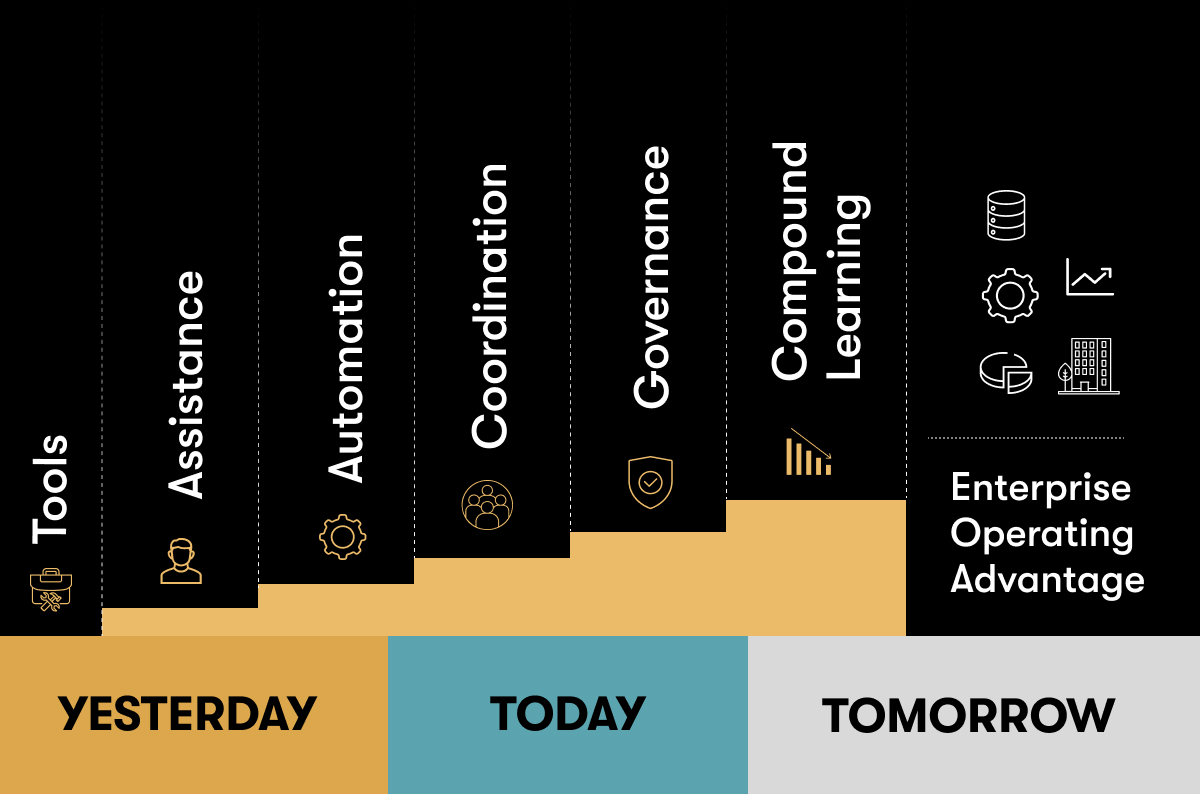
The model shows AI moving from assistance to automation, then coordination, governance, and compounding learning. Not by adding more tools. That is when AI stops being a novelty and starts shaping how companies work.
Value appears when redesigned workflows produce better results repeatedly across teams, markets, and use cases.
A WORKING DEFINITION OF AI INSIDE THE BUSINESS
Think of AI as a layered system, not a single tool.
- Operating model: people, governance, routines, metrics, and decisions that determine whether AI creates business value
- Workflow: how teams use AI in discovery, planning, design, delivery, support, and iteration
- Capability: models, data access, orchestration, guardrails, evaluation, and platforms



Today's Imbalanced AI Investments

This is where many firms get stuck. They invest heavily in the bottom layer and over-index on model choice but underinvest in the middle and top layers where value is either created or lost. The difficulty isn’t getting a model to generate an answer; it’s making the answer usable, trusted, governed, and integrated into the workflow with clear ownership.
PRODUCT, PROGRAM, PLATFORM
Many companies still run AI like a normal feature backlog with a bit of data science attached (think of people who shout “Agile!” but slide down their Waterfall). That approach breaks down quickly because AI introduces more ambiguity, evaluation questions, organizational learning loops, and more need for shared standards.
AI delivery requires three connected accountabilities: Product, Program, and Platform.
- Product owns the problem, the user, the desired behavior change, and the business outcome
- Program owns cross-functional coordination, prioritization, governance rhythms, change management, and dependency removal
- Platform owns shared tooling, model access, evaluation frameworks, observability, security, and reuse
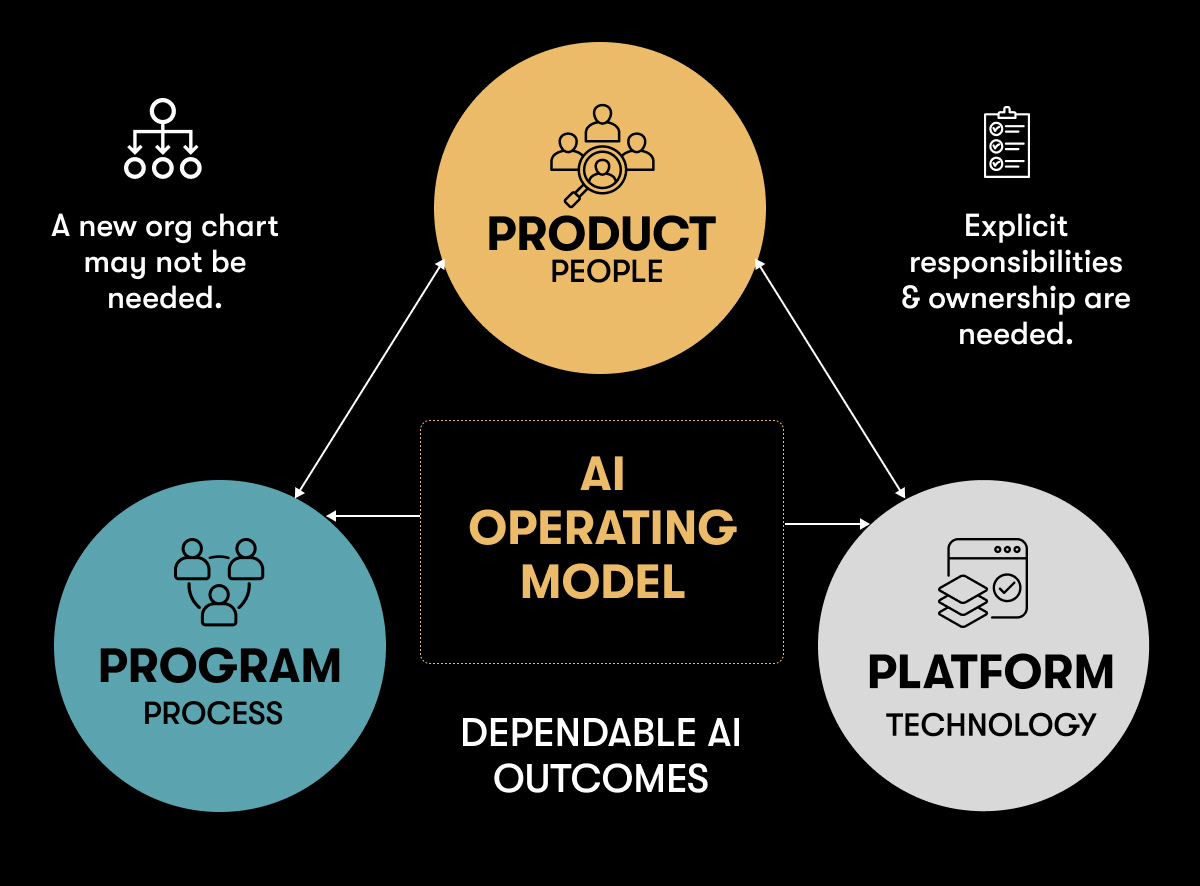
Here, a new org chart may not be required. Responsibilities must be explicit, and their owners must meet through a regular operating cadence. If ownership is fuzzy, teams will ship activity rather than outcomes.
WHEN “GOOD” STARTS TO LOOK GOOD
Getting to “good” means knowing what to measure. Efficiency, quality, economics, impact, adoption, and governance are the answers. Leaders should baseline the current state before introducing AI so they can test whether the new workflow improves the job.
In an AI-native product organization, the unit of work is likely to become smaller, faster, and more evidence-backed. Product managers will spend less time manually generating first drafts and more time deciding which problems matter, what trade-offs are acceptable, and where judgment still needs to be applied. Product managers must be grounded in the user now more than ever before.
Program managers will spend less time chasing updates and more time designing execution systems that keep teams aligned around facts, dependencies, decisions, and risk (dynamic RAID logs). Directors will spend less time asking for status and more time shaping the operating rhythm that turns experimentation into dependable output.
This does not mean humans become less important. It means human value shifts upward. The differentiators become framing, sequencing, taste(https://www.youtube.com/shorts/j8sI8i6p018), escalation judgment, prioritization, communication quality, and the ability to make work stick across functions. As routine synthesis becomes cheaper, clarity becomes more valuable.
HOW WAYS OF WORKING CHANGE
Companies getting the most from AI redesign how work flows, not just the tools people can access. Four changes are most visible in product, program, and platform operating models.
1. More structured brief, earlier quality assurance
AI works best with clear input. In an AI-first operating model, briefs, requirements, and decision memos must specify the job, context, constraints, quality bar, risk level, and evaluation method. Explicitly, and from the start. Clear inputs improve early quality assurance for human and AI-produced work.
2. Shortened iteration loops
Work that once took days now happens in hours. Drafting, synthesis, design exploration, and requirements decomposition are accelerated. But that only improves outcomes if the review loop is equally disciplined. Faster production without faster decision-making simply creates a bigger backlog of half-finished material.
3. More continuous cross-functional communication
AI reduces the cost of producing updates, summaries, and options. That means communication can become more frequent and more decision oriented. Good teams will use AI to keep everyone aligned on the latest version of the problem, the options, the risks, and the next decision. This means fewer, more impactful meetings.
4. Reuse will matter more than raw velocity
Long-term advantage comes from reusable prompts, evaluation sets, decision templates, policy patterns, and workflow components – all reusable. Fast teams may impress at first. Reusable teams will outperform over time.
WHAT PRODUCTS AND PROGRAM MANAGERS NEED TO DO DIFFERENTLY
For product managers, the biggest shift is from authoring everything manually to designing the conditions for high-quality output. That means stronger problem framing, clearer acceptance criteria, tighter connection to user value, and better judgment about where AI helps versus where it distracts.
For program managers, the shift is from coordination by status gathering to coordination by system design. The strongest program leaders will build operating cadences, risk routines, escalation paths, and dependency maps that make AI-enabled delivery repeatable across functions.
They need to speak both technical and business language, through the eyes of the user. This is design thinking in an AI-first world.
For directors, the shift is from sponsoring experiments to building the environment where good experiments can become default ways of working. That includes role clarity, metrics, governance, staffing, platform choices, and the willingness to stop fragmented efforts that do not scale.
A SIMPLE END-TO-END EXAMPLE
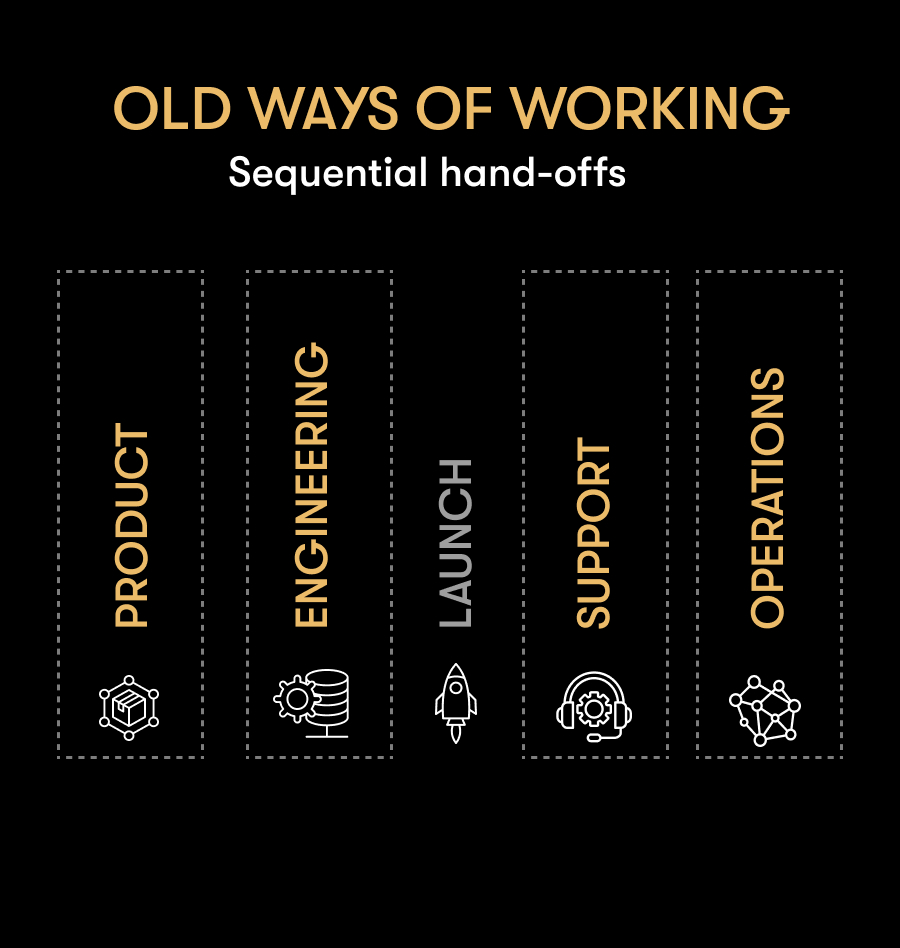
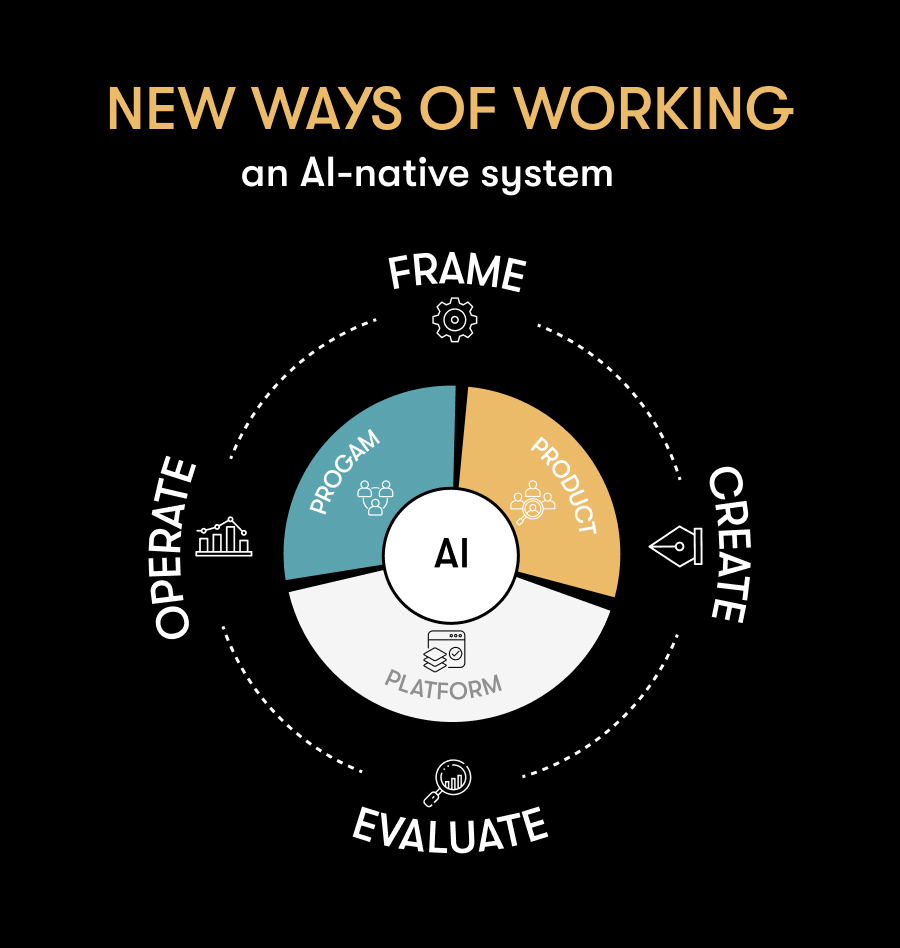
Consider a company shipping an AI-assisted support product for enterprise customers. In a traditional setup, product writes a brief, engineering builds a feature, support reacts later, and operations scrambles to update knowledge content after launch.
In an AI-native setup, the flow is different.
- Product defines the user job, the success metric, and the quality bar
- Program sets the cross-functional cadence, risk checkpoints, and launch decisions
- Platform provides the retrieval pattern, evaluation harness, observability, and guardrails
This produces faster launches and a tighter learning loop between concept, production, usage, and improvement. Companies should be careful not to revert to disconnected hand-offs.
WHAT THIS MEANS FOR FINISHED PRODUCTS
The gap between strong and weak AI organizations will not be technical talent. It will be organizational design. AI amplifies whatever operating model already exists. In a clear system, it speeds up value creation. In a messy system, it speeds up noise.
| STRONG AI ORG | WEAK AI ORG |
|---|---|
 Strong Pattern Strong Pattern |
 Weak Pattern Weak Pattern |
 Clear ownership Clear ownership |
 Diffuse ownership Diffuse ownership |
 Shared evaluation standards Shared evaluation standards |
 Ad hoc quality judgment Ad hoc quality judgment |
 Reusable workflows Reusable workflows |
 One-off heroics One-off heroics |
 Governance in the workflow Governance in the workflow |
 Governance after the fact Governance after the fact |
 Cross-functional operating rhythm Cross-functional operating rhythm |
 Fragmented updates and slow escalation Fragmented updates and slow escalation |
 Business-linked metrics Business-linked metrics |
 Tool usage vanity metrics Tool usage vanity metrics |
We see that most clearly inside the business. Many of the most important AI products will be internal: sharper briefs, faster synthesis, better prioritization, stronger hand-offs, cleaner knowledge, and more disciplined communication. These are products too, because they shape how the company performs. The firms recognizing this early will ship better customer-facing products as well, because their internal production system will be stronger.
PRACTICAL CHECKLIST TOWARD AN AI-FIRST OP MODEL
Directors and senior managers do not need every answer up front, but they do need a point of view. A strong starting position would include the following:
- Define where AI should change the work, not just where it can be inserted
- Make product, program, and platform responsibilities explicit
- Standardize the inputs: briefs, templates, quality criteria, and launch checks
- Create one shared rhythm for prioritization, evaluation, and escalation
- Invest in upskilling and product reuse so learning compounds across teams
- Measure business outcomes and workflow quality, not just volume of AI activity
These actions are practical because they link strategy to operating behavior. They also show a way of thinking that is valuable in leadership roles: AI is both a technological system and a management system.
CLOSING VIEW
The leaders who matter most in that shift will be the ones who can organize people, process, and technology into a faster, clearer, more dependable system of production.
Make the grocery list. Get the ingredients. Cook the thing properly. Plate it well. Then serve something with taste that beckons for seconds.
The views and opinions expressed in this blog are those of the author and do not necessarily reflect the official position or perspective of Photon.
Sources
The State of AI in 2025: Agents, Innovation, and Transformation | McKinsey says AI value depends on operating model, workflow redesign, talent, data, and scaling. | McKinsey & Company | 2025-11-04 |
https://www.mckinsey.com/capabilities/quantumblack/our-insights/the-state-of-ai
AI ROI: The Paradox of Rising Investment and Elusive Returns | Deloitte says AI investment is rising, but returns remain elusive without stronger operating discipline and scale. | Deloitte | 2025-10-21 |
https://www.deloitte.com/uk/en/issues/generative-ai/ai-roi-the-paradox-of-rising-investment-and-elusive-returns.html
Organizational Transformation in the Age of AI: How Organizations Maximize AI’s Potential | WEF says value comes from end-to-end organizational redesign, not isolated pilots. | World Economic Forum | 2026-03-15 |
https://www.weforum.org/publications/organizational-transformation-in-the-age-of-ai-how-organizations-maximize-ais-potential/
Enterprise AI Operating Model Report 2026 | A 2026 operating-model report focused on governance bodies, decision rights, AI literacy, controls, and maturity. | Alice Labs | 2026-04-22 |
https://alicelabs.ai/reports/enterprise-ai-operating-model-2026
McKinsey State of AI 2025: Agents, Innovation, and Enterprise Transformation | Secondary summary of McKinsey’s 2025 findings| Libertify | 2026-04-17 |
https://www.libertify.com/interactive-library/mckinsey-state-of-ai-2025-agents-innovation-transformation/
State of AI 2025: McKinsey Report | Secondary summary and visual guide to the McKinsey report. | Libertify | 2026-04-17 |
https://www.libertify.com/interactive-library/state-of-ai-2025-mckinsey-report/
AI Governance Trends / CEO governance report | A recent governance-focused report useful for governance and ownership sections. | IBM | 2025-12-08 |
https://www.ibm.com/thought-leadership/institute-business-value/en-us/report/ai-governance-trends