Intro
First in a three-part series on The Cost of Indecision. In an age of abundant intelligence, the greatest strategic risk is not simply choosing wrong. It is losing value while the organization works its way toward a decision.
Most companies still believe their biggest strategic risk is making the wrong move.
Increasingly, it is not.
It is the value lost before a move is ever made.
That is the shift many leadership teams still underestimate. We are operating in an environment of abundance: more intelligence, more options, more analysis, more stakeholders, more scenarios, more reasons to keep a decision in motion without ever fully making it.
The constraint is no longer access to insight.
It is the organization’s ability to convert insight into action before the value begins to erode.
What reads as rigor on the inside often shows up as delay on the outside. Markets are not especially patient with delay.
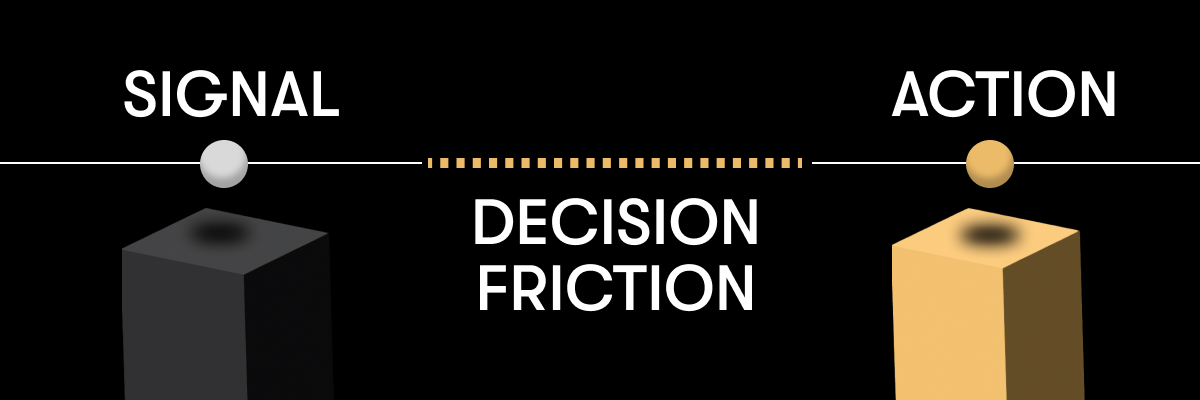
That gap has a name: decision friction. It is the drag that builds between recognizing the need to act and actually doing so. It shows up in delay, stakeholder sprawl, repeated rework, and the slow dilution of accountability as decisions move farther from the work.
More intelligence is not creating more movement
For years, the management logic was simple: better strategy comes from better information.
That made sense when information was scarce and expertise was concentrated.
It makes less sense now.
Today, intelligence is abundant. But better inputs have not automatically produced better movement. In many organizations, they have produced the opposite.
More intelligence creates more analysis. More analysis expands alignment. More alignment widens the stakeholder circle. More stakeholders create more caution, more rework, and more reasons to revisit what should already be moving.
The decision gets more sophisticated. The organization gets slower.
That is the problem.
Not the quality of thinking.
The time, complexity, and diffusion that accumulate between recognizing the need to act and actually doing something about it. That gap has become one of the most underappreciated sources of performance drag in modern business.
Value is being lost in the decision process
Most companies still treat indecision as a leadership issue.
Sometimes it is.
More often, it is structural.
Too many decisions still move through a familiar chain:
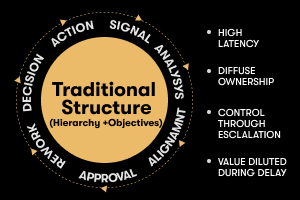
Signal → Analysis → Alignment → Approval → Rework → Decision → Action
Every stage may seem reasonable in isolation.
Together, they create a system in which value leaks before action ever begins.
Ownership is shared, so accountability blurs. More stakeholders enter late, so cycles expand. Decisions are made, then reopened. Analysis sharpens the case, but postpones commitment. Approvals preserve control, but slow momentum.
This is what makes the issue dangerous. It rarely looks reckless. It often looks disciplined.
But the commercial consequence is the same: delay, dilution, and lost advantage.
Indecision is not just frustrating.
It is expensive.


The structure is the story
The deeper issue is that most organizations are still built to escalate decisions, not absorb them.
That design made sense in a slower world.
It does not fit this one.
Today, value often decays while the organization is still working through the process. A growth opportunity narrows while functions align. A customer issue lingers while ownership is debated. An AI initiative generates enthusiasm, pilots, and presentations while the harder operating decisions are deferred. A transformation effort remains visible without becoming consequential.
In each case, the issue is not awareness.
It is conversion.
The organization sees the signal. It just cannot convert it into action fast enough to preserve the value at stake. That is why this is not primarily a conversation about decisiveness as a leadership trait. It is a conversation about whether the enterprise is designed to move at the speed the market now demands.
A simpler way to frame it
Decision effectiveness is shaped by three things: the value at stake, the quality of the decision, and the friction involved in getting to it.
A decision can be strategically sound and still commercially weak if too much value drains away before it is acted on.
That is the part many organizations miss.
They focus on improving decision quality. They spend far less time examining what the process itself is doing to decision value.
That is where the contrast between models becomes useful.
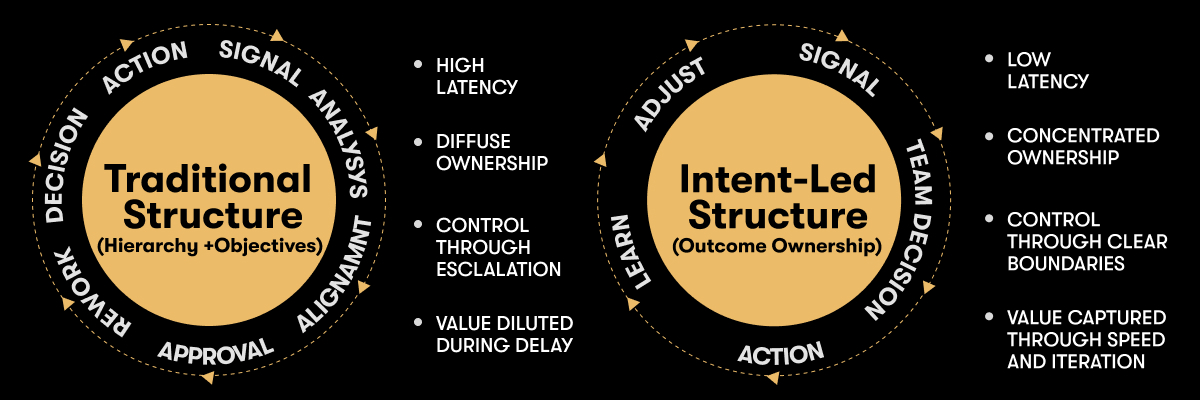
Traditional structure
Signal → Analysis → Alignment → Approval → Rework → Decision → Action
This model tends to optimize decision quality through control. The tradeoff is slower movement, broader dependency, and delayed value realization.
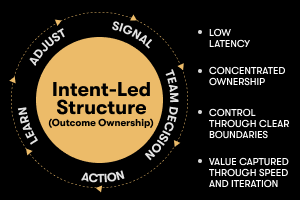
Intent-led, outcome-oriented structure
Signal → Team Decision → Action → Learn → Adjust
This model pushes decisions closer to the work, inside a team with a clear objective, defined boundaries, and accountability for the result. It does not remove risk. It changes how risk is managed.
In the first model, value is diluted during the path to action.
In the second, value is captured faster through movement and iteration.
What this looks like in practice
Take a simple example.
A leadership team identifies an AI-enabled service opportunity with real upside. The market case is credible. Product sees the fit. Technology wants feasibility work. Finance wants a stronger commercial model. Legal wants guardrails. Sales wants clearer positioning.
None of those questions are unreasonable.
But the decision now begins to travel.
Across functions. Up the hierarchy. Back for refinement. Into another review. Then another alignment cycle.
Twelve weeks later, the organization may have more confidence.
But it almost certainly has less advantage.
That is the point executives should care about most.
The cost is not just the time spent deciding. It is the value lost while the opportunity remains trapped between interest and action.
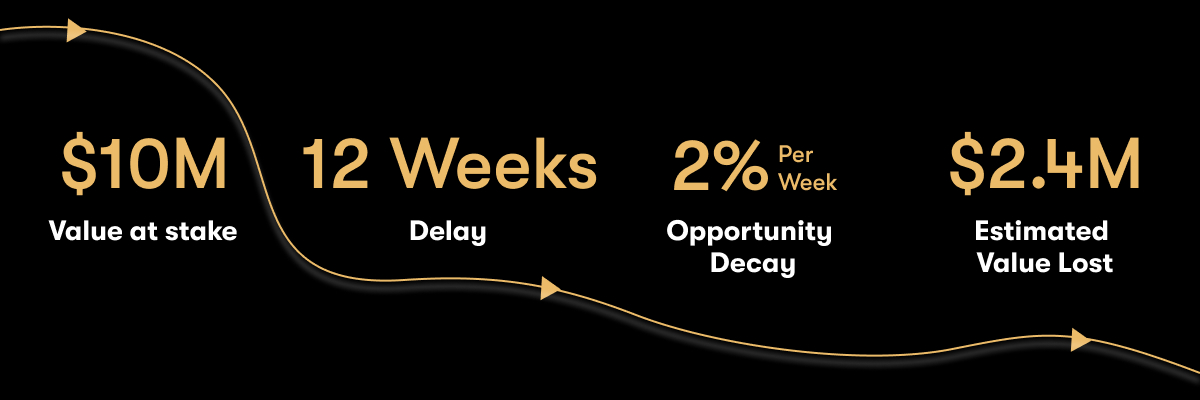
A useful way to size that loss is to ask three questions: what value is at stake, how long the organization is taking to commit, and how quickly that value erodes while the decision is delayed.
If the opportunity is worth $10 million, the commitment takes 12 weeks, and the advantage decays by 2 percent per week, the commercial loss is not theoretical.
It is real.
Delay has economics.
Why this matters more now
AI will not reduce the need for judgment. It will increase the number of choices, scenarios, and recommendations organizations have to process.
That means companies with slow, approval-heavy, high-dependency structures may become even more congested.
More intelligence will not automatically create more movement.
In some organizations, it will create more hesitation disguised as sophistication.
The question is no longer whether the organization can generate enough insight.
In most cases, it can.
The question is whether it can act before the value of that insight begins to decay. That is increasingly the test that matters most.
What leaders should examine now
Start with one live decision that matters.
Not a hypothetical one. A real one already in motion.
Trace the path it is taking. How long it has been in process. How many groups have touched it. How often it has been reopened. Where ownership is sharp and where it becomes diffuse. Whether the process is genuinely improving the outcome, or simply preserving comfort.
Not all delay is useful.
Not all control preserves value.
And not all rigor improves effectiveness.
The better question is not, “How do we make better decisions?”
It is, “How do we reduce decision friction before a decision becomes action?”


The real risk
Strategy is not breaking because leaders suddenly have less intelligence.
It is breaking because many organizations still lose too much value in the time it takes to act on what they already know.
That is the risk.
Not bad strategy in the abstract.
Not lack of analysis.
Not lack of options.
The real risk is that the organization mistakes a longer path to decision for a stronger one, while the value at stake quietly deteriorates in the background.
The organizations that outperform will not be the ones with the most information. They will be the ones that treat decision friction as a design problem to solve—not a byproduct of complexity to accept.
Inaction is not neutral. Value moves even when you do not.
Next: Why growth often slows inside the organization before it slows in the market.
The views and opinions expressed in this blog are those of the author and do not necessarily reflect the official position or perspective of Photon.