Recap
Now that we’ve framed this shift beyond the lens of a typical tech cycle and diagnosed why traditional strategy feels broken, we turn to the structural solution: how organizations can build systems designed to sense, adapt, and create in motion.
Why Strategy Feels Harder Than Ever
We Are Starting to Build Systems That Behave More Like Humans.
Strategy in the Creative Economy
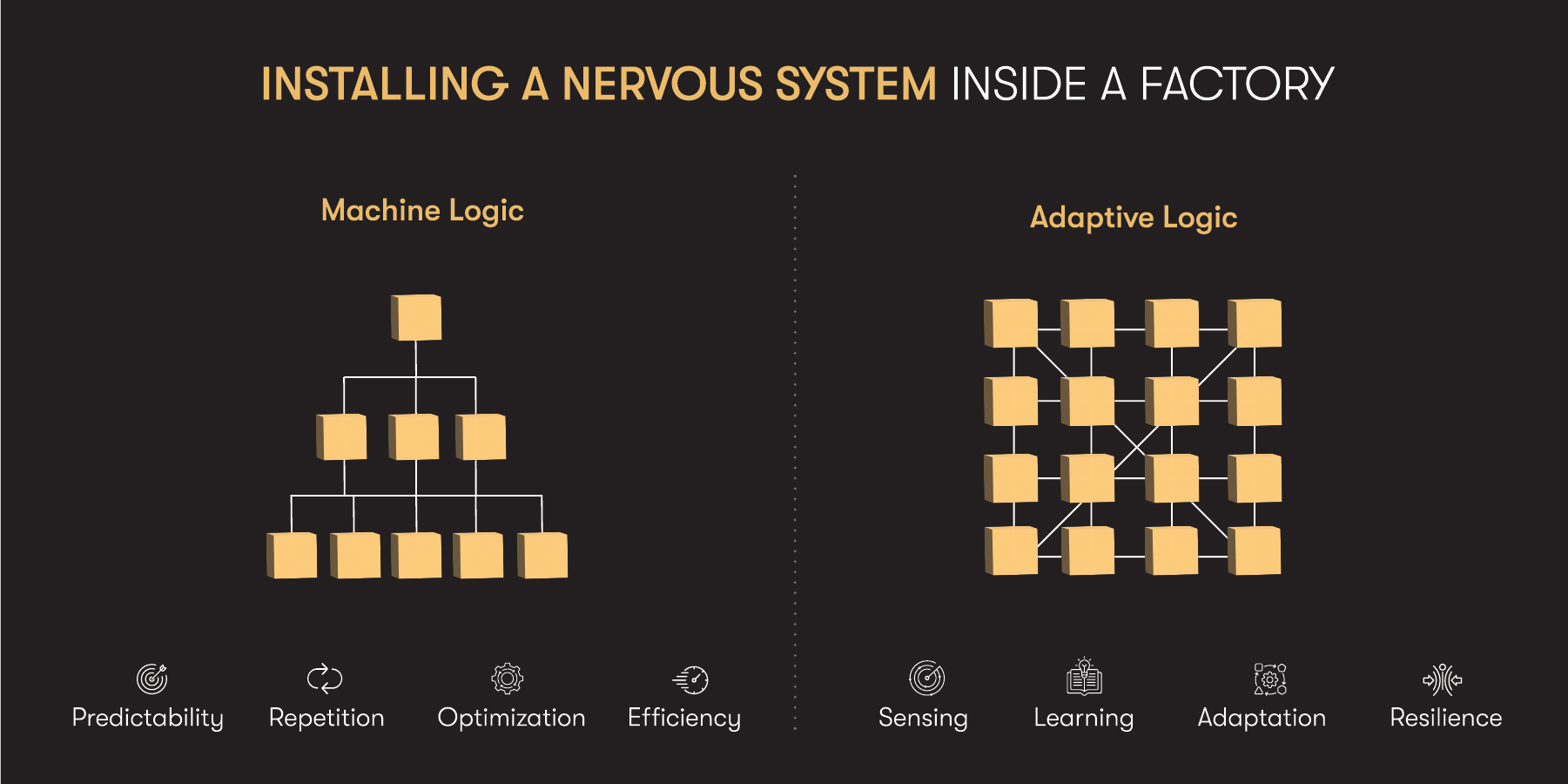
For most of modern business history, companies were designed like machines.
Predictable.
Structured.
Repeatable.
That made sense in the industrial economy.
Factories succeeded through consistency.
Processes scaled through standardization.
The goal was reducing variation.
But the technologies now reshaping business no longer behave like machines.
AI learns through feedback.
Robotics adapts through interaction.
Digital products evolve continuously through use.
Intelligent systems improve as they encounter the world.
We are not building conscious systems.
We are building adaptive systems.
Systems that sense.
Learn.
Adjust.
Respond.
In many ways, we are beginning to build systems that behave more like humans.
Not because we planned it that way.
Because adaptive systems outperform rigid ones in environments that change rapidly.
That shift changes everything.
How products are built.
How organizations operate.
How strategy works.
How businesses evolve.
The industrial economy rewarded organizations that could repeat.
The creative economy rewards organizations that can learn.
And for the first time in modern business history, evolution itself is becoming the strategy.
Most organizations are not built for this world.
They are still optimized for:
- stability over adaptation
- control over sensing
- planning over learning
- efficiency over resilience
That is why so many enterprises feel slower every year while the world accelerates around them.
The Old Model Worked When Change Was Slow
For decades, strategy was treated like architecture.
You studied the market.
Built the plan.
Allocated the budget.
Executed carefully.
The best companies were the ones that could predict the future most accurately.
And for a long time, that worked.
Markets moved slower.
Technology cycles lasted longer.
Customer expectations evolved gradually.
But today, the environment changes while organizations are still discussing the roadmap.
AI compresses months of work into hours.
Products evolve weekly.
Customer behavior changes in real time.
Industries shift before annual planning cycles finish.
The future no longer waits for certainty.
And that changes the role of strategy completely.
Strategy is no longer just planning.
It is building systems that can:
- sense continuously
- learn continuously
- adapt continuously
- create continuously
- maintain trust at scale
That is the operating model emerging across business and technology.
Kodak Failed for a Reason Most Companies Still Ignore
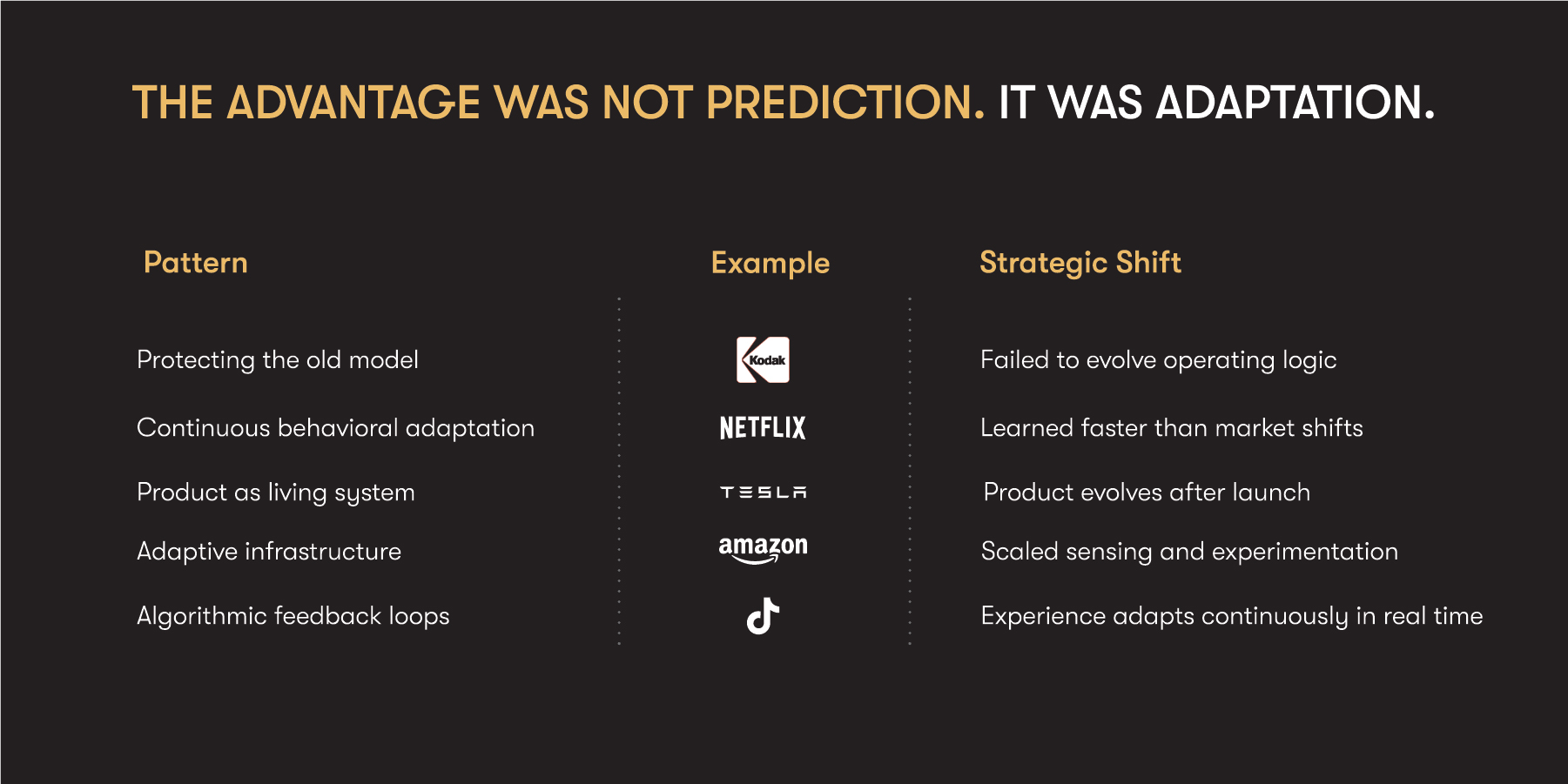
Kodak is often described as a company that missed the future.
That is not quite right.
Kodak invented one of the first digital cameras in 1975.
The problem was not innovation.
The problem was adaptation.
Kodak’s operating model was built around protecting the existing film business.
Its systems optimized for preserving certainty instead of evolving with change.
Meanwhile, the environment moved.
Customers changed.
Technology changed.
Behavior changed.
Kodak did not fail because it could not see the future.
It failed because its organization could not evolve fast enough once the future arrived.
That same tension now exists inside many companies today.
They have the technology.
They have the ideas.
They have the signals.
But their systems are still designed to protect the current model.
That is the quiet risk.
Not missing the future.
Failing to adapt once it is visible.
Products Are No Longer Finished
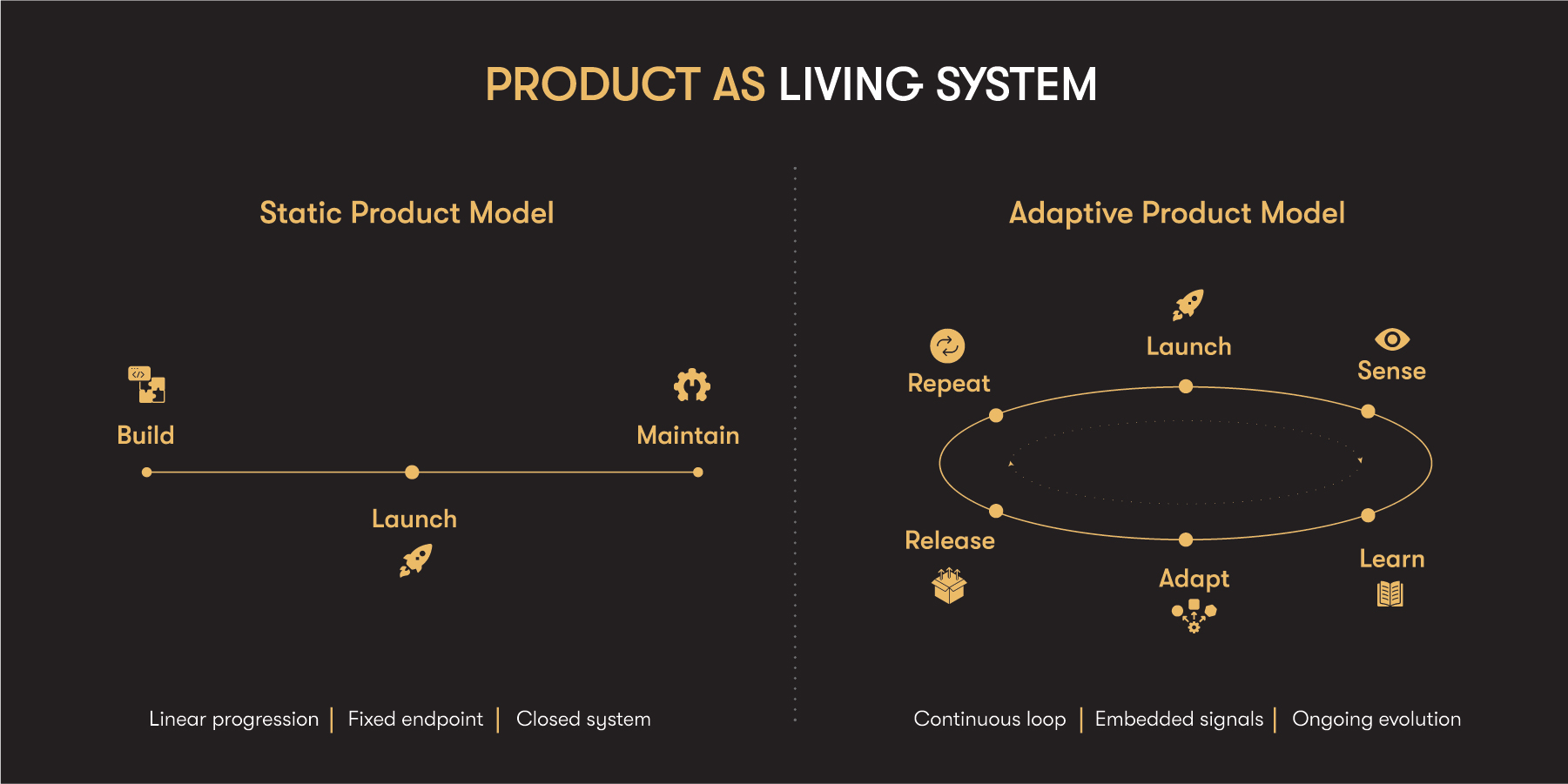
In the past, products behaved like movies.
You spent years building them privately.
Then released the final version to the public.
Launch was the finish line.
Today, products behave more like living systems.
They evolve continuously.
Features change weekly.
Interfaces adapt dynamically.
AI personalizes experiences in real time.
Launch is no longer the end.
Launch is the beginning of learning.
Tesla changed expectations in automotive by making the car behave more like adaptive software than a static machine.
Software updates add capabilities.
Interfaces evolve.
Driving systems learn.
Customer behavior reshapes development priorities.
The same logic is spreading across industries.
The product itself becomes part of the learning system.
That changes the role of the enterprise.
A company is no longer just building products.
It is building systems that continue learning after release.
Technology Is Forcing Organizations to Change
This shift is not happening because executives suddenly changed management philosophy.
The technology itself is forcing the transition.
Traditional software behaved like a machine.
Fixed rules.
Predictable outputs.
Controlled behavior.
Modern intelligent systems behave differently.
They learn.
They sense.
They adapt.
AI models improve through interaction and feedback.
Robotics systems adjust to changing environments.
Digital platforms evolve through usage data.
Eventually, organizations begin resembling the technologies they depend on.
That may be one of the most important shifts happening in business right now.
Adaptive technologies do not fit neatly inside rigid operating models.
The organization has to change around them.
This Is Why So Many Organizations Feel Stuck
Many companies are trying to operate adaptive technologies inside rigid organizational systems.
It is like installing a nervous system inside a factory.
The technology wants to learn continuously.
The organization wants to slow everything down.
That tension defines much of modern business today.
Adaptive systems only work if they can continuously sense reality.
Humans survive because we constantly absorb signals from the environment.
Opportunities.
Threats.
Feedback.
Patterns.
Friction.
Then we adjust behavior.
A human driving a car does not check the road once every quarter.
We continuously sense and respond.
Modern organizations are beginning to operate the same way.
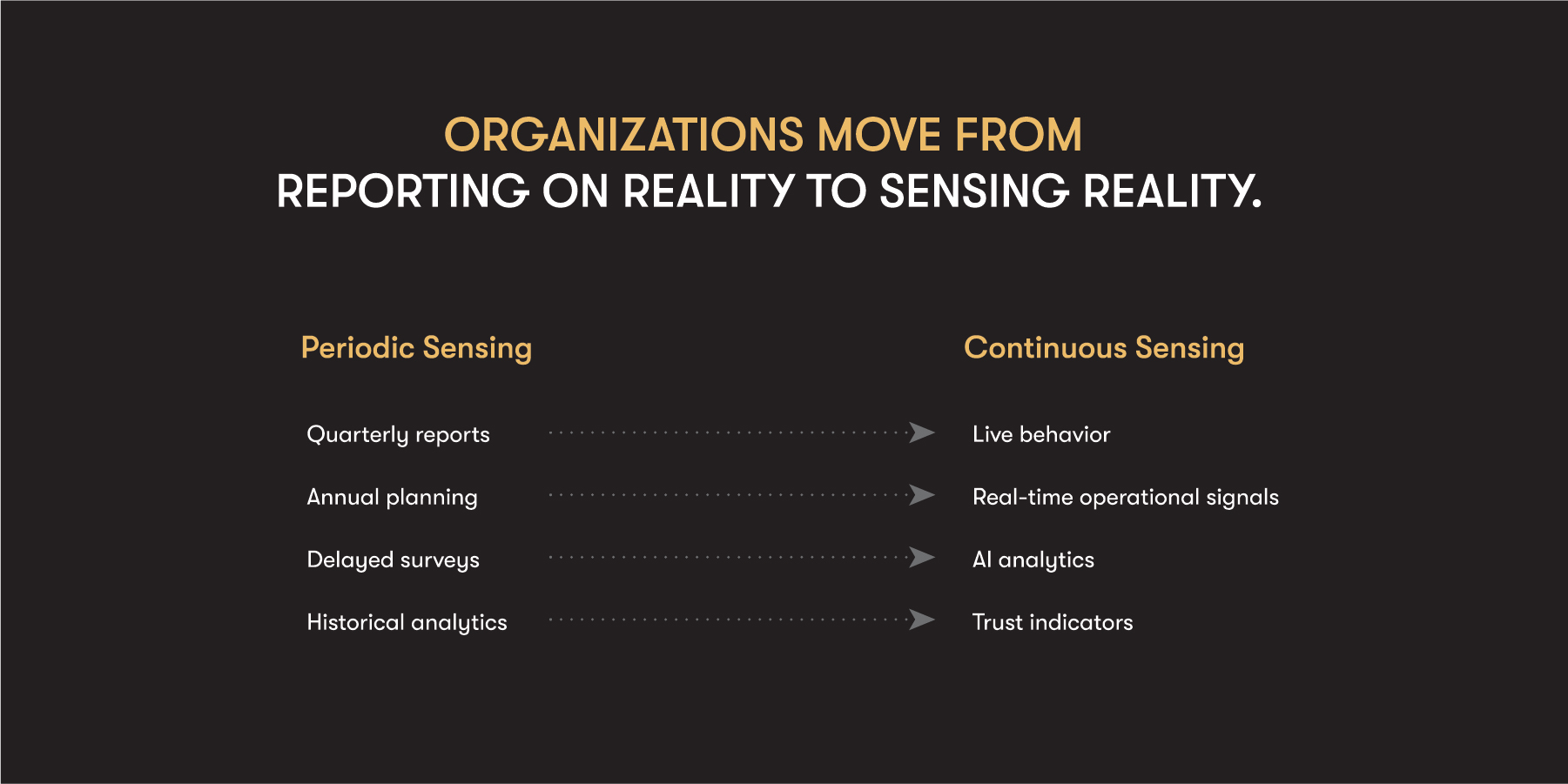
The industrial enterprise sensed the market periodically.
Quarterly reporting.
Annual planning.
Delayed surveys.
Historical analytics.
The creative economy operates through continuous sensing.
Real-time customer behavior.
AI-driven analytics.
Live operating signals.
Dynamic market feedback.
Trust signals.
This changes strategy fundamentally.
Strategy no longer behaves like a static annual plan.
It becomes a continuous sensing and adjustment system.
AI-native companies often feel faster because they are not waiting to react after the environment changes.
They are sensing change while it happens.
Feedback Is Becoming More Valuable Than Forecasts
Industrial systems valued forecasts.
Creative systems value feedback.
Forecast thinking asks:
“What do we think will happen?”
Feedback thinking asks:
“What is reality telling us now?”
One depends on assumptions.
The other depends on signals.
Netflix survived multiple industry transitions because it learned faster than competitors.
That is the new advantage.
Instead of making one giant irreversible decision, adaptive organizations make thousands of smaller learning decisions.
That creates something powerful:
Speed without full commitment.
The industrial economy optimized for planning before action.
The creative economy optimizes for learning during action.
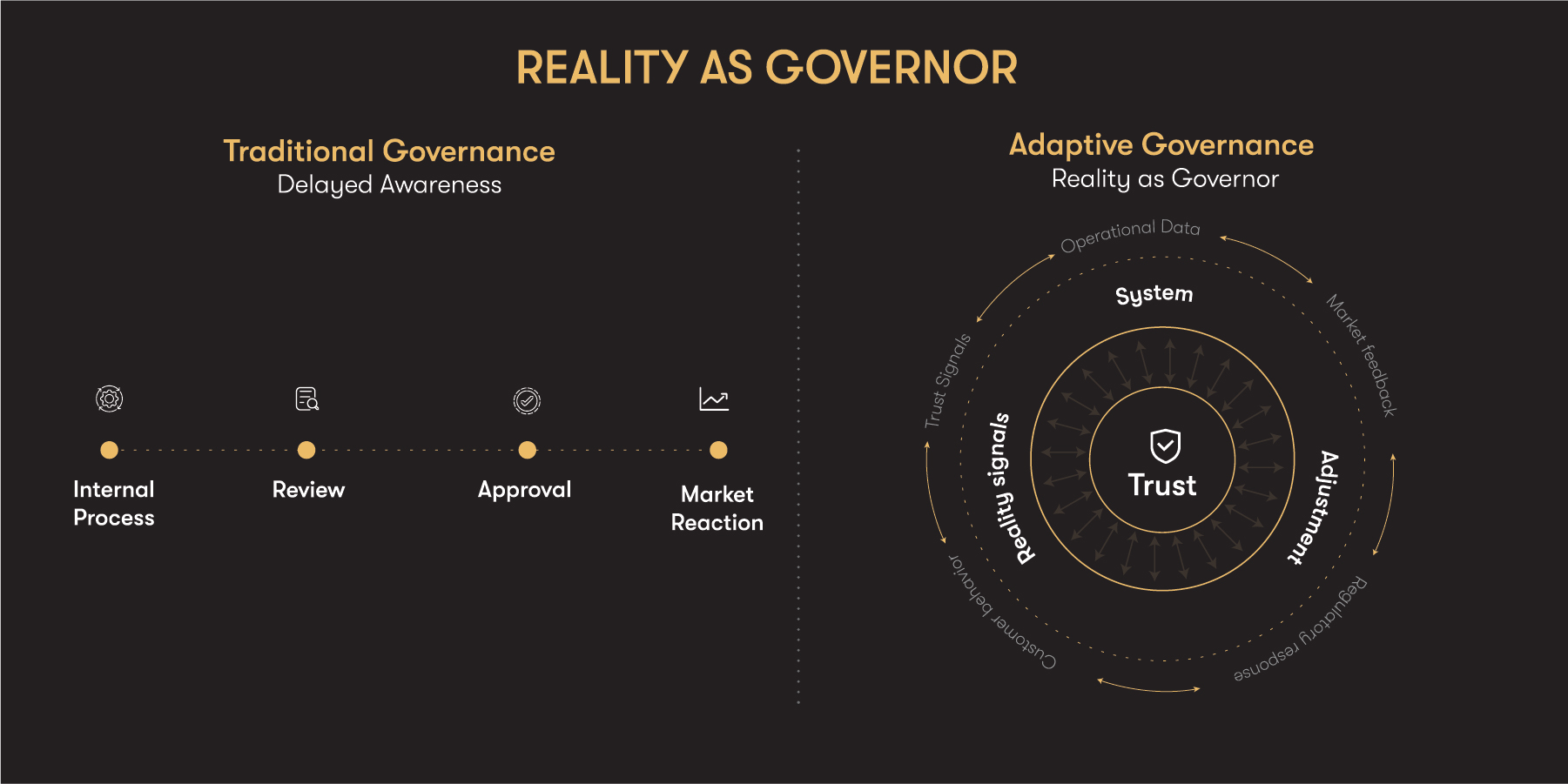
Reality Is Becoming the Governor
At this point, many executives become nervous.
Because creation sounds risky.
And it can be.
If everyone moves faster, does everything become chaos?
Not if the system is designed correctly.
Modern adaptive systems develop new governors.
Increasingly, reality itself becomes the steering mechanism.
Customers reject bad experiences immediately.
Trust breaks publicly.
Operations expose weak processes quickly.
Markets punish waste rapidly.
Regulators respond faster than before.
The feedback loop has compressed.
Years ago, organizations could operate with delayed awareness.
Today, one poor AI rollout or trust failure can trigger:
- backlash
- customer loss
- regulatory attention
- reputational damage
- market reaction
Reality now governs faster than internal process.
That does not mean governance disappears.
It means governance must move closer to real-world feedback.
The strongest organizations will not be the most rigid.
They will be the most adaptive without losing trust.
The Adaptive Creation Loop
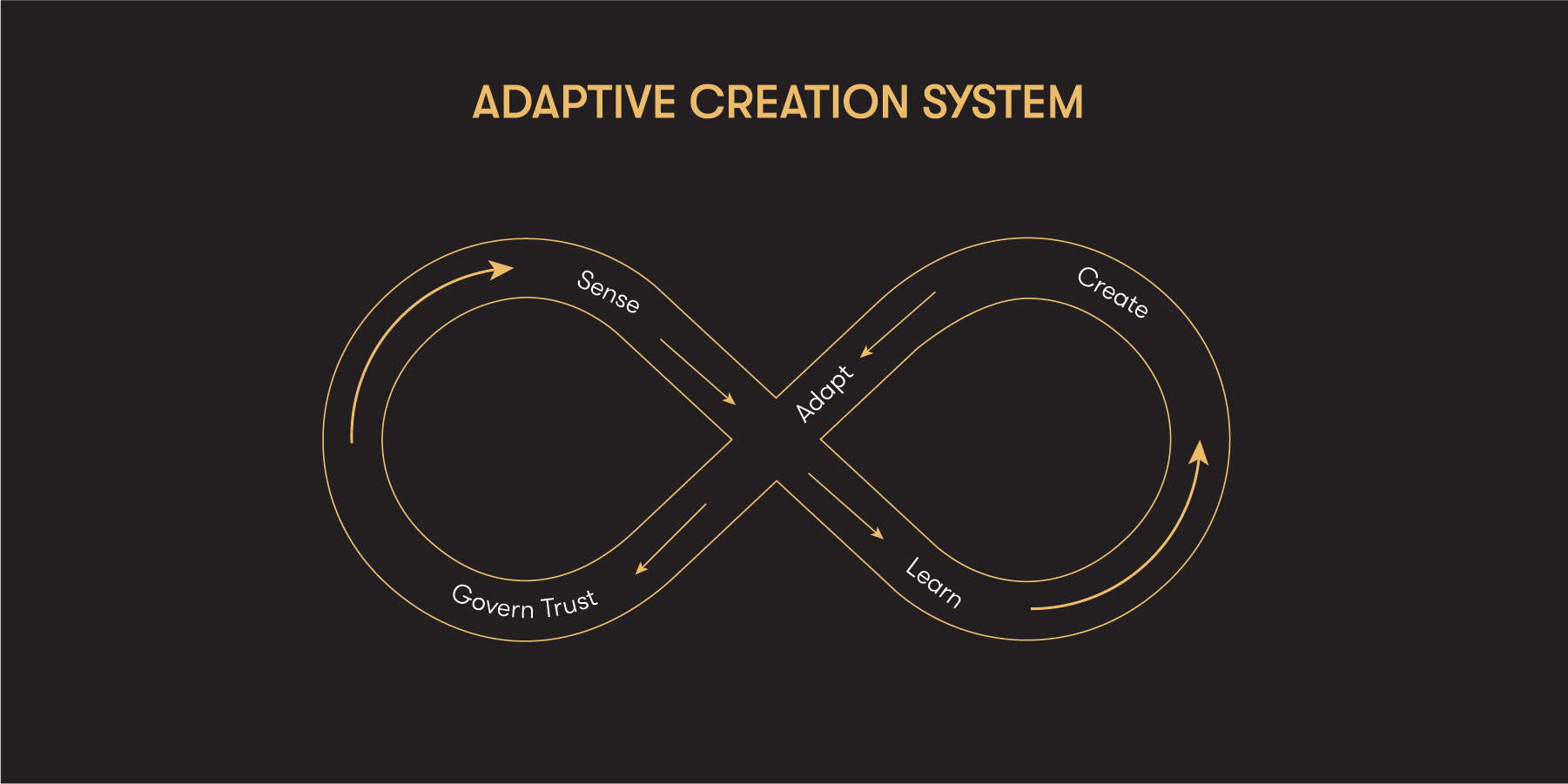
The organizations thriving in the creative economy are not operating through static plans.
They are operating through continuous loops.
1. Sense
Continuously observe the environment.
2. Learn
Interpret what the signals actually mean.
3. Adapt
Adjust behavior quickly.
4. Create
Launch new value into the market.
5. Govern Trust
Ensure speed does not break confidence.
Then the loop starts again.
The companies that dominate the next decade will not be the ones with the most polished static plans.
They will be the ones running this loop fastest without losing trust.
The New Competitive Advantage
For decades, scale was the advantage.
Then data became the advantage.
Now adaptive intelligence is becoming the advantage.
Because when AI lowers the cost of creation, differentiation shifts elsewhere.
The winners become the organizations that can:
- sense continuously
- learn continuously
- adapt continuously
- create continuously
- maintain trust while evolving at speed
That is why strategy is changing from prediction to participation.
The future is no longer something organizations observe from a distance.
It is something they shape continuously through interaction.
The companies that dominate the next decade will not necessarily have the best five-year plans.
They will have the best systems for learning in motion.
Shape
The Real Challenge Starts Now
But creation introduces a dangerous new problem.
If everyone can build faster,
if AI compresses execution,
if experimentation becomes continuous,
then speed itself becomes risky.
Moving fast without trust creates instability.
The industrial economy rewarded organizations that could repeat.
The creative economy will reward organizations that can evolve.
But evolution cannot be left to chance.
It has to be designed.
That is where the next question begins.
If strategy is becoming a continuous act of sensing, learning, adapting, and creating, then organizations need a new way to run it.
Not another planning process.
Not another innovation workshop.
Not another AI tool.
They need a creative operating system.
One that brings humans and AI into the same strategic workflow.
One that helps teams move from signal to insight, from insight to prototype, and from prototype to learning.
One that turns strategy into something organizations can create, test, and evolve in real time.
That is where we go next.
In the next post, we explore Vibe, a creative operating system for strategy, and ask the question that matters most:
Does this actually work in the real world?
The views and opinions expressed in this blog are those of the author and do not necessarily reflect the official position or perspective of Photon.