The New Frontier: Content as the Core of Marketing Transformation
Marketing has entered a new era in which data, content, and automation operate as a single interconnected system. Technology has delivered remarkable precision and efficiency, yet the broader MarTech environment still functions as a collection of loosely connected tools that struggle to meet the speed of modern consumer expectations.
More than eight years ago I wrote about the value of metadata and the important role it played for Marketing Teams investing heavily in content creation and distribution. At the time, the industry was only beginning to recognize that the metadata embedded within creative assets held meaningful insight that could drive strategy, inform performance, and reveal new opportunities. In that earlier work, I described metadata as an essential differentiator and a critical source of intelligence that had long been overlooked. Today, that insight has expanded beyond optimization. Metadata has become infrastructure.
Metadata is now the connective tissue of the marketing ecosystem, linking creative, media, analytics, CRM, CDP, CMS, DAM, and AI systems. Traditional Digital Asset Management platforms were originally designed for storage and rights management, but the metadata they produce now unlocks dynamic processes that allow Marketing Teams to create, optimize, and govern content in real time. Metadata transforms DAM from a static archive into an operational engine that supports intelligent decision making.
This shift changes how Marketing Teams are structured. Metadata can no longer sit as a back-office taxonomy exercise owned solely by operations. It becomes a strategic capability jointly owned by marketing, analytics, and technology leaders. AI prompt design, metadata governance, and content performance modeling become formal responsibilities rather than ad hoc tasks. Teams must decide who defines brand rules for AI systems, who validates training data, and who owns model performance.
Why now? Because AI systems are already influencing search visibility, content discovery, and customer interaction. If Marketing Teams do not define their metadata and AI governance frameworks, external platforms and algorithms will interpret their content on their behalf. Without adaptation, organizations risk fragmentation, inconsistency, and declining relevance in AI mediated environments.
In this environment, metadata also becomes one of the most important forms of training data for proprietary AI systems. The more structured and intentional the metadata, the more accurate, safe, and reliable the AI becomes. This positions metadata not only as an informational asset but as a strategic resource that shapes model behavior, tone, style, creative rules, and brand identity across AI generated content.
The Intelligent Content Ecosystem
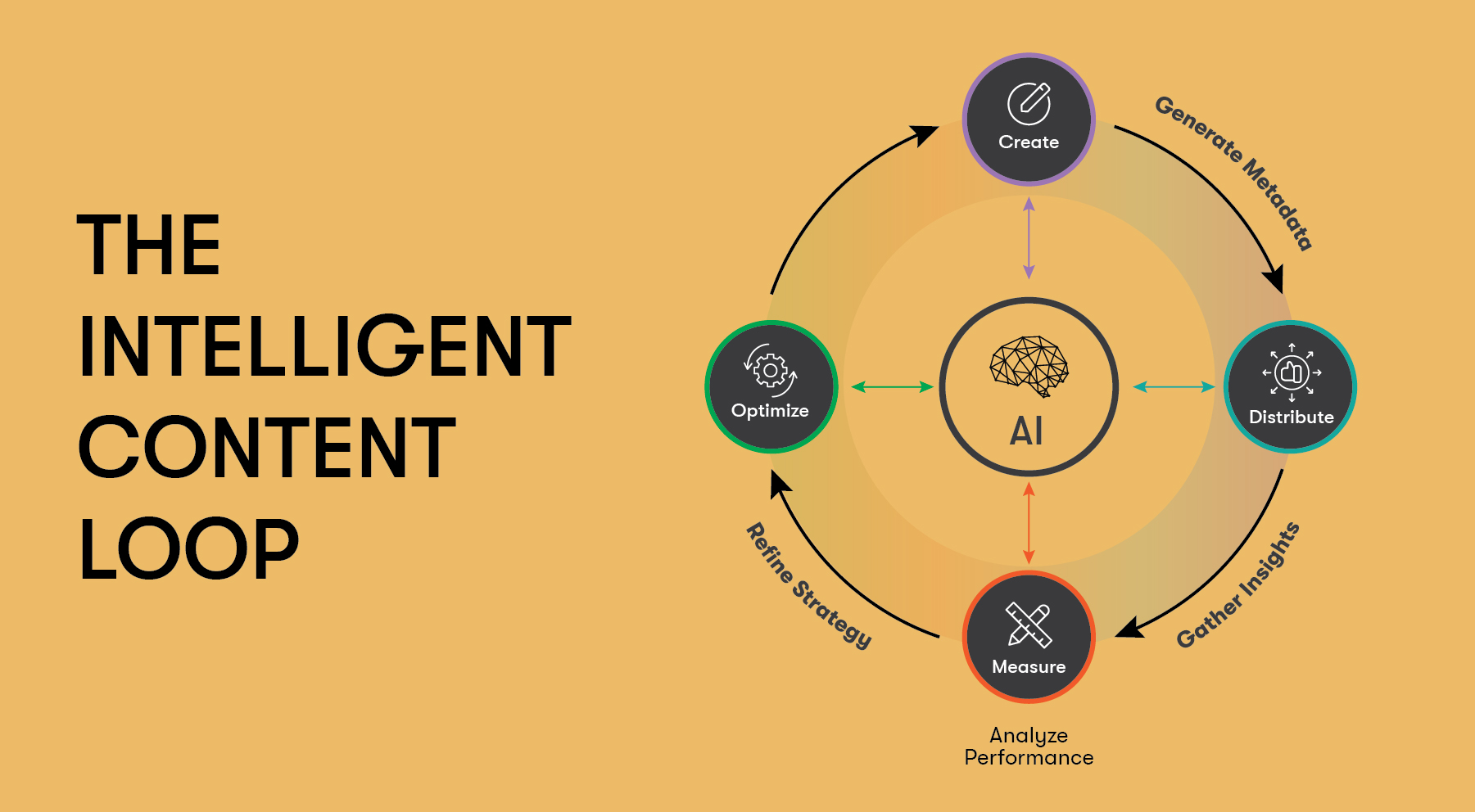
When metadata was first treated as a strategic asset, connecting systems required manual effort, custom integrations, and heavy human oversight. Intelligence was extracted after the fact. Today, AI enables intelligence to flow continuously.
Artificial intelligence has transformed the MarTech environment into a fluid and connected ecosystem. DAM platforms integrate with AI models, automation tools, and analytics systems. However, control does not reside in a single system. Instead, orchestration emerges across DAM, CMS, CRM, analytics platforms, and API gateways through shared metadata standards, governance rules, and integration architecture.
DAM becomes a creative operations engine not because it controls everything, but because it anchors structured assets and metadata. AI automates enrichment and flow across connected systems, eliminating friction that once slowed teams down. Campaign briefs now require structured inputs. Analytics feeds creative refinement earlier in the lifecycle. Content performance becomes visible at the asset level rather than only at the campaign level.
Operationally, this changes how teams work. Content planning, creative development, analytics, and technology functions become interdependent. Organizations must define who owns the feedback loop between analytics and creative production. Without clear ownership, AI workflows stall or operate in silos.
AI agents now support creation, classification, delivery, and optimization. Metadata becomes the connective element within AI powered workflows, linking generative content to audience response in real time. Every asset informs the next one. The content supply chain becomes a learning system.
If Marketing Teams fail to integrate systems and define ownership, AI remains a tactical tool rather than an infrastructural capability. The result is experimentation without scale.
The New Metrics: From Metadata to Market Data
Measurement has always been central to marketing, but AI and metadata redefine what can be measured and how insights influence decisions. In the past, creative performance was evaluated using high-level engagement metrics that provided limited diagnostic value. Today, asset level intelligence is possible.
Content Intelligence indicators such as Creative Elasticity, Metadata Velocity, and Content ROI allow Marketing Teams to understand not just what worked, but why it worked and how it can be replicated or adapted. These indicators support the development of a Creative Intelligence Graph, a continuous model connecting asset attributes, audience behavior, and market performance. This shifts organizations from retrospective reporting to predictive insight.
Decision making changes. Creative reviews occur earlier. Budget allocation increasingly favors assets that demonstrate adaptability and longevity. Media optimization becomes integrated with creative optimization rather than treated separately. Without adopting these metrics, Marketing Teams risk optimizing media spend while underinvesting in creative performance, even though creative increasingly drives conversion outcomes in AI mediated channels.
Ethics and Transparency in an AI Enabled Content Supply Chain
As AI becomes embedded in content operations, governance becomes as important as generation. Content origin tracking ensures Marketing Teams can see where assets were created, how AI was involved, and what changes were made along the way. Watermarking and content origin signals provide clarity around AI involvement. These practices reduce risks associated with misinformation, compliance breaches, and reputational exposure.
Model governance is equally critical. Metadata used to train AI systems must be accurate, ethical, and aligned with brand standards. Governance defines who approves prompts, who validates outputs, and who retains override authority.
AI can generate variants, enforce structural rules, and recommend optimization strategies, but humans remain accountable for narrative direction, ethical boundaries, regulatory compliance, and strategic positioning. Governance frameworks must clearly define approval thresholds and audit rights. These safeguards ensure that human oversight remains central, even as automation accelerates production. Without governance, automation scales risk alongside scale of output.
The Meaningful Value Realized by Modern Marketing Teams
When AI and metadata operate within a unified ecosystem, the impact is both operational and economic.
Operationally, repetitive tagging, routing, and variation production become automated. Production cycle time shortens. Campaign velocity increases. Creative teams focus on higher order work rather than manual execution.
Economically, the cost structure of content production shifts. Variable creative costs decline as AI generates variants at scale. Investment increases in metadata governance and system integration. Over time, organizations experience higher content yield per campaign, improved asset reuse, and stronger return on creative spend.
Marketing Teams gain deeper understanding of which attributes drive engagement and conversion. Personalization becomes real time and scalable. Metadata functions as structured intelligence guiding AI systems and reinforcing brand consistency.
If organizations do not adapt, content costs rise while competitors scale personalization and optimization more efficiently. The gap becomes structural, not incremental.
The Road Ahead: The Human and Machine Marketing Organization
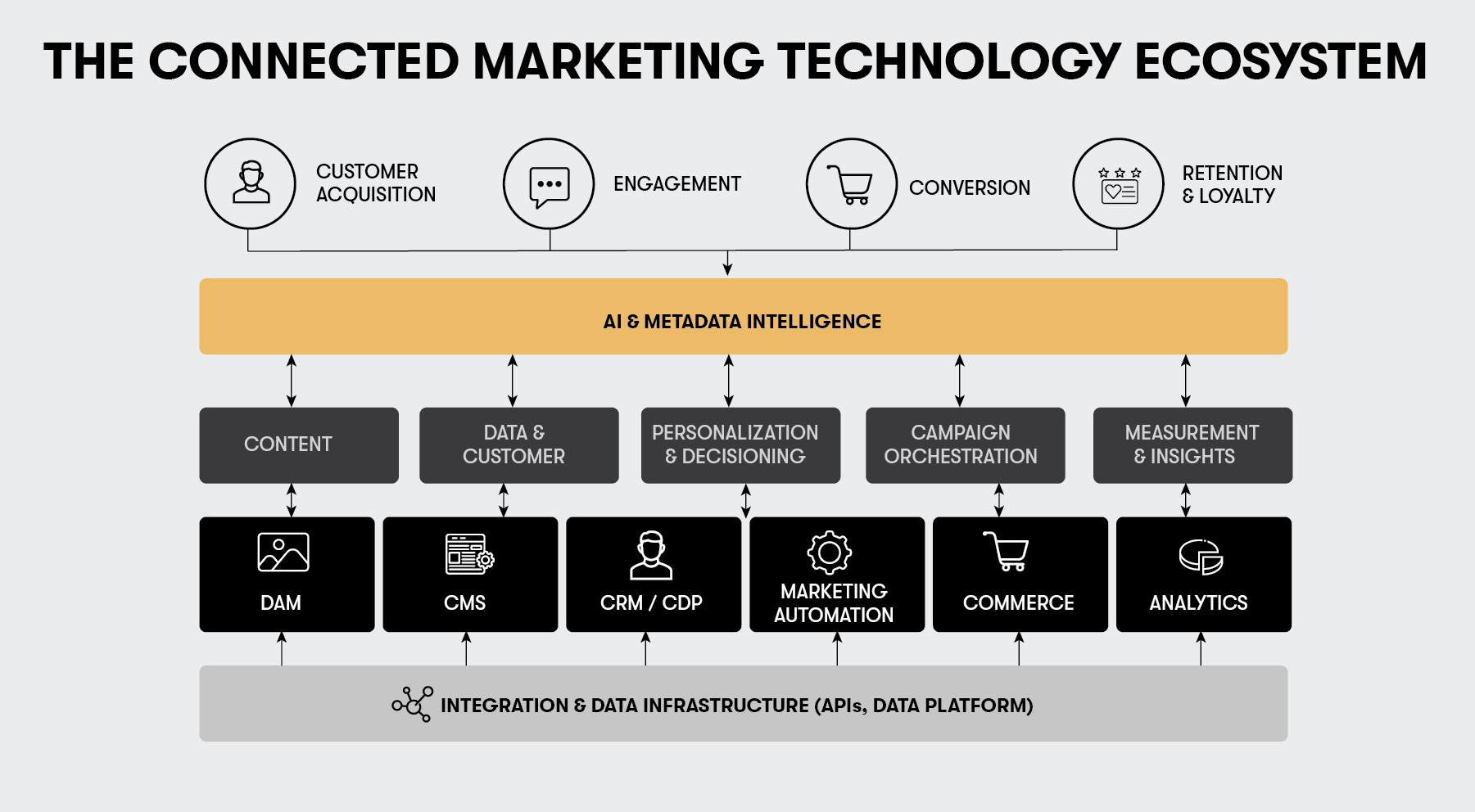
The future of marketing is not defined by AI replacing humans, but by clearly defining how humans and machines collaborate. AI expands creative reach by automating production, analysis, and variant generation. Humans retain ownership of strategy, positioning, narrative architecture, and ethical judgment. DAM, CMS, CRM, analytics, and AI platforms form an integrated infrastructure. Control is distributed through governance frameworks, metadata standards, and system integration rather than centralized in a single tool.
If AI is treated as an experiment rather than infrastructure, organizations will experience fragmented pilots, inconsistent outputs, and duplicated effort. Without structured metadata, governance, and system ownership, AI remains incremental rather than transformative.
In this era, every asset becomes data, every dataset becomes creative, and metadata becomes the bridge that transforms both into intelligence. Marketing Teams that operationalize this shift will not simply adopt AI. They will redesign how content is produced, measured, governed, and valued.
The views and opinions expressed in this blog are those of the author and do not necessarily reflect the official position or perspective of Photon.