Recap
In the previous article we explored how artificial intelligence is collapsing the cost of intelligence.
This Is Not Another Tech Cycle
Intro
When intelligence becomes abundant, the economics of value creation begin to change.
Services evolve toward creativity.
Knowledge becomes easier to access.
Small teams gain capabilities that once required large organizations.
This shift moves the economy toward a Creative Economy.
But it creates a new problem.
Strategy was designed for a world that no longer exists
Applying it the same way now produces weaker outcomes, not better ones.
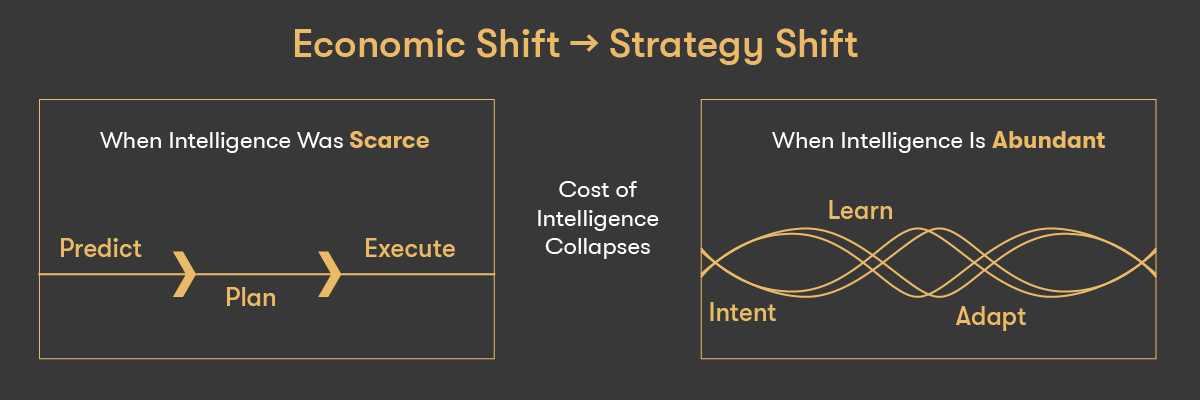
Strategy Was Built for Stability
Traditional strategy evolved in relatively stable environments.
Markets moved gradually.
Technology advanced in waves.
Competitive advantage could last decades.
Under those conditions, strategy resembled building a railroad.
Leaders studied the terrain.
Predicted where markets would move.
Committed to a path.
Predict
Plan
Execute
This worked because the environment moved slowly enough for prediction to remain useful.
It relied on a deeper assumption.
The future could be approximated with enough analysis and time.
That assumption no longer holds.
Strategy worked because the world moved slowly enough to be understood before it changed.
Intelligence Just Became Cheap
Artificial intelligence collapses the cost of intelligence.
Knowledge that once required entire departments is now accessible instantly.
This changes the structure of the system.
More people can experiment.
More ideas emerge.
Innovation accelerates.
As intelligence becomes abundant, average thinking loses value.
Change behaves less like a wave and more like weather.
Constant.
Variable.
Difficult to forecast.
Strategy did not fail.
The environment changed shape.
Strategy feels harder because organizations are navigating systems evolving at different speeds.
When intelligence is cheap, thinking is no longer the constraint. Direction is.
The Two Operating Systems Problem
Most organizations now operate inside two systems.
The enterprise system governs stability.
Planning cycles.
Hierarchy.
Control.
Alongside it, an innovation system emerges.
AI-augmented work.
Rapid experimentation.
Small creative teams.
These systems move at very different speeds.
Ideas move quickly.
Processes move slowly.
The result is misalignment.
Innovation stalls in pilots.
Decisions slow as they scale.
Control increases as uncertainty rises.
This is not a technology issue.
It is structural.
The Third Rail Economy
Organizations also operate within a regulatory system evolving at its own pace.
Policy moves deliberately.
Innovation accelerates.
This creates a third layer of tension.
Organizations must navigate between:
- Innovation speed
- Enterprise stability
- Regulatory evolution
Some domains become high-risk zones.
Move too slowly and fall behind.
Move too quickly and increase exposure.
More industries will operate in this condition.
Advantage will depend on navigating boundaries, not just building capability.
The boundary is no longer technical. It is institutional.
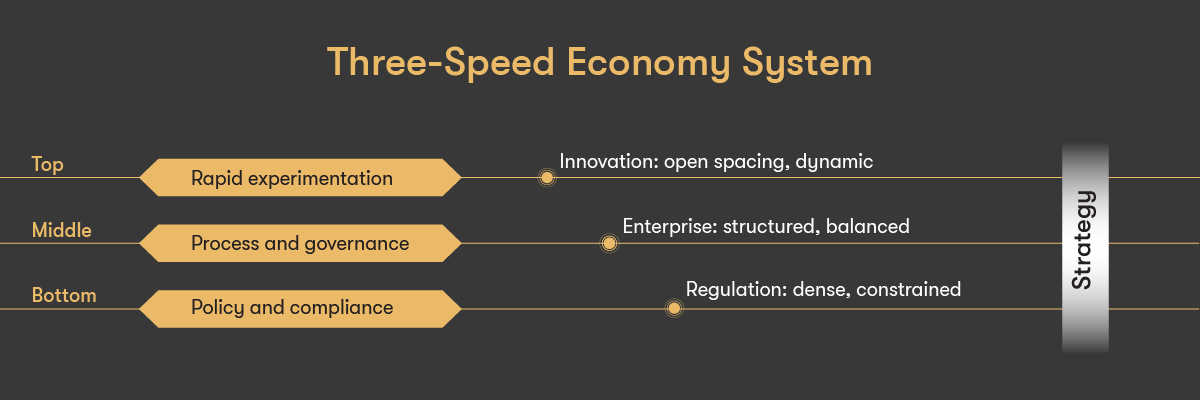
The Three-Speed Economy
Organizations now operate across three speeds.
Innovation accelerates.
Enterprises adapt.
Regulation evolves.
Strategy no longer lives inside the enterprise. It exists at the intersection of systems moving at different speeds.
Strategy Has Faced Transitions Before
Shipping once relied on sails.
Steam engines emerged but were initially limited.
For a period, both systems coexisted.
Operators worked across two models.
As steam improved, infrastructure adapted.
The old system faded.
Organizations are experiencing a similar transition.
From knowledge economies to intelligence economies.
The challenge was not adopting steam. It was operating both systems at the same time.
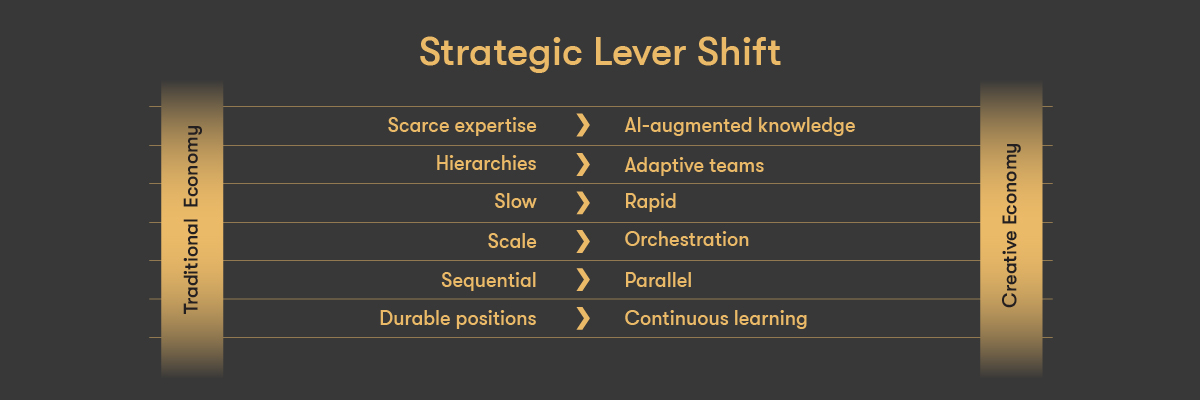
The Strategic Levers Are Moving
This is not one shift. Its multiple shifts happening at once, reinforcing each other.
Multiple levers are shifting at once.
Intelligence
From scarce expertise to AI-augmented knowledge
Organization
From hierarchies to adaptive teams
Experimentation
From slow to rapid
Value Creation
From scale to orchestration
Regulation
From sequential to parallel
Competitive Advantage
From durable positions to continuous learning
These shifts are simultaneous.
The system behaves like an ecosystem, not a machine.
Risk Is Changing Shape
Strategy has always been about managing risk.
Previously, risk meant making the wrong large bet.
Now experimentation is cheaper.
Ideas can be tested quickly.
Feedback arrives earlier.
Small failures matter less.
Learning too slowly becomes the risk.
Over-optimization becomes a liability.
Waiting for certainty becomes delay.
The goal shifts from certainty before action to learning while moving toward intent.
The biggest risk is no longer being wrong. It’s learning too slowly to matter.
Strategy as Navigation
Strategy is no longer a plan. It’s a system for learning in a specific direction.
In nonlinear environments, prediction weakens.
Navigation becomes the dominant model.
The destination remains clear.
The path adjusts continuously.
Intent defines direction.
Learning shapes movement.
Constraints guide decisions.
Navigation depends on continuous sensing.
It cannot be centralized.
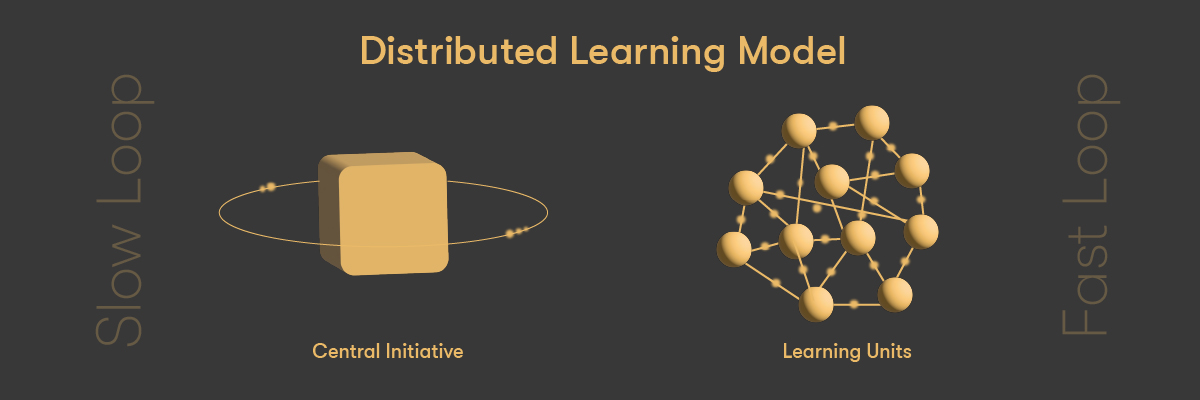
Smaller Units of Learning
Large initiatives optimize for efficiency. Small units optimize for learning.
Organizations adapt through smaller units.
Large initiatives move too slowly.
Smaller units learn faster.
Innovation cells
Micro businesses
Cross-functional teams
These units align with where value forms.
Progress comes from many small explorations, not a few large bets.
How Leaders Can Approach the Transition
Operating across three systems creates tension.
Innovation accelerates.
Processes stabilize.
Regulation evolves.
The goal is not replacement.
It is navigation.
Leadership shifts.
Anchor intent.
Enable continuous learning.
Design guardrails, not gates.
Leaders are no longer the source of answers. They are the designers of learning systems. They design how the system learns.
The Real Question
Organizations are not choosing between systems.
They are operating between them.
Prediction alone can no longer guide strategy.
Navigation replaces planning.
Less forecasting.
More learning.
Less certainty.
More intentional movement.
In the industrial economy, advantage came from scale.
In the knowledge economy, from information.
In the creative economy, from learning faster with intent.
Strategy is no longer just about choosing a path.
It is about creating one while moving.
When prediction weakens, intent becomes the anchor.
The organizations that win will not be the ones that plan best.
They will be the ones that learn fastest in clear direction.
If the future cannot be predicted with confidence, it must be shaped through action.
That changes the role of strategy entirely.
The question is no longer what will happen.
The question becomes:
What are we going to create, and how will we learn fast enough to make it real?
That is where strategy is going next.
In the next post, we explore what it means for strategy to become a creative act.
The views and opinions expressed in this blog are those of the author and do not necessarily reflect the official position or perspective of Photon.