CUSTOMER GROWTH FUNNEL
AWARENESS
CONSIDERATION
CONVERSION
RETENTION

Standfirst: This is the second installment in The Cost of Indecision, a three-part series on how organizational friction erodes value before action begins. Part 1 examined what happens when decisions take too long. Part 2 looks upstream at growth: before a market slows, an organization often slows first, through fragmented ownership, competing priorities, and too much distance between opportunity and action.
When growth slows, most leadership teams look outward.
Demand softened. Customers changed. Competition intensified. Budgets tightened.
Sometimes that diagnosis is right.
But there is another possibility executives should examine just as closely:
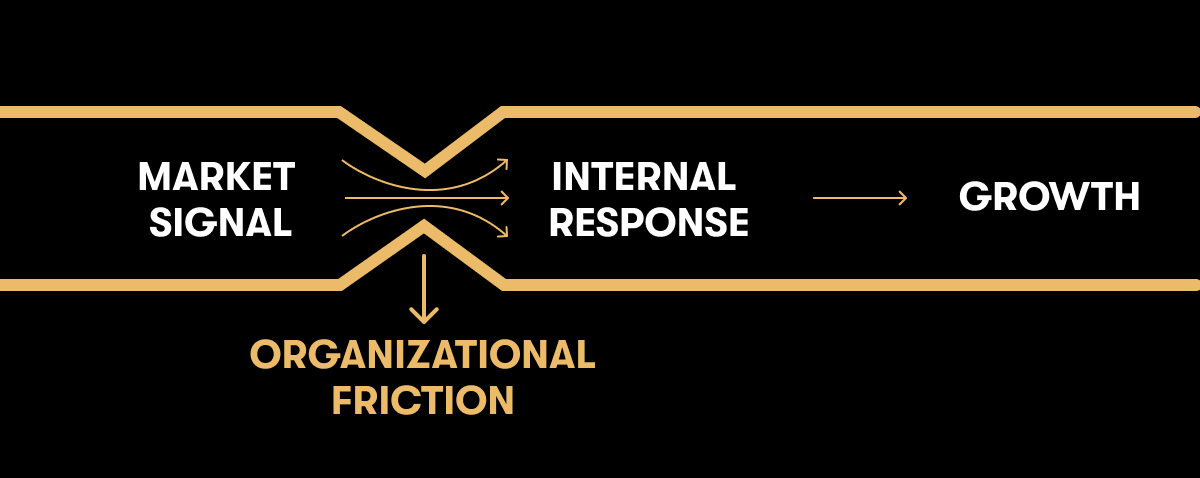
The market may not be the first thing slowing down. The organization may be.
What looks like a demand problem can begin as a prioritization problem. What looks like an innovation problem can begin as an ownership problem. And what eventually appears as weak execution may be the downstream consequence of taking too long to decide where to place a bet.
That matters because growth does not begin when a customer converts.
It begins much earlier, with the enterprise’s ability to recognize an opportunity, commit to it, and move while the opportunity still has value.
That is often where growth starts to leak.
Companies are very good at measuring the visible end of growth: revenue, pipeline, conversion, retention, market share.
But these are largely lagging indicators. By the time they deteriorate, the underlying condition may have been building inside the enterprise for months.
A promising opportunity was identified but never clearly owned. Funding lagged behind conviction. A proposition stayed in refinement long after it was ready to test. A known customer problem crossed too many organizational boundaries to resolve quickly. A pilot demonstrated value, but no one owned the decision to scale it.
The symptom eventually appears in the market.
The cause may have started inside the business.
This is how companies with smart people, sound strategies, credible ideas, and real customer opportunity still underperform. The issue is not always whether they can see what is changing.
It is whether they can convert what they see into movement fast enough.
So instead of asking only, Why isn’t the market responding?
leaders should also ask:
How much of the opportunity we originally saw actually made it to market?
The market may not be the first thing slowing down. The organization may be.
Most companies know their customer funnel:
Awareness → Consideration → Conversion → Retention
But every opportunity has to survive another funnel first, inside the enterprise:
Signal → Prioritize → Commit → Fund → Execute → Learn
That internal funnel determines how much of the original opportunity ever reaches the customer.
This is where entirely rational organizational behavior can become collectively expensive.
Commercial wants urgency. Technology wants feasibility. Finance wants confidence. Legal wants guardrails. Operations wants capacity. Leadership wants alignment.
None of those needs are unreasonable.
Together, they can turn opportunity into a queue.
A market signal becomes an initiative. The initiative becomes a business case. The business case enters governance. Governance creates dependencies. Dependencies create delay.
The organization eventually moves.
But later, and often with less differentiation, less momentum, and less upside than when the opportunity first appeared.
One of the most persistent assumptions inside large organizations is that an opportunity will wait.
It will not.
Customer needs evolve. Competitors respond. Budgets shift. New priorities arrive. Internal enthusiasm fades. The people closest to the original signal move on.
So the initiative that eventually reaches market may technically be the same initiative, but economically, it is no longer the same opportunity.
It has decayed.
A company can make the strategically correct move and still capture a fraction of its original potential because it arrived too late.
That is why elapsed time alone is the wrong measure.
The better measure is opportunity decay: how much of the original advantage survives the journey from signal to action.
Imagine an opportunity worth $20 million today. Six months from now, the underlying demand may still exist. But if competitors have moved, customers have adapted, or differentiation has narrowed while the business aligns internally, that opportunity no longer carries the same strategic premium.
The opportunity may survive.
The advantage may not.
That is the growth implication of Part 1: decision quality matters, but so does how much value survives the path to action.
A delayed opportunity is rarely the same opportunity later.
The organizations most exposed to this problem rarely look inactive.
Quite the opposite.
They are full of workshops, pilots, roadmaps, steering committees, business cases, dashboards, and transformation programs. Viewed from inside the enterprise, enormous amounts of work are happening.
That is precisely why internal growth drag can be difficult to see.
Activity becomes a proxy for progress.
A pilot signals innovation. A roadmap signals direction. A steering committee signals governance. A workshop signals alignment.
All may be useful.
None, on their own, create growth.
Growth begins when resources move, behavior changes, something reaches the market, and the organization learns from reality.
Everything before that is potential.
And potential has a shelf life.
Part 1 argued that many enterprises are designed to escalate decisions rather than absorb them.
That same architecture has a direct growth consequence.
Every dependency adds distance between opportunity and action.
If a meaningful growth move requires five functions, several approval layers, a steering committee, and executive escalation, the business is not simply adding governance.
It is adding latency.
This is not an argument against hierarchy or control. It is an argument for distinguishing necessary control from unnecessary dependency.
The strongest operating models move enough context, authority, and accountability toward the work that teams can act inside clear boundaries without repeatedly sending decisions back up the organization.
That is the logic behind intent-led, outcome-oriented teams: the objective is clear, the boundaries are clear, the outcome has an owner, and the team has enough authority to move.
It changes a fundamental operating question.
Instead of:
Who else needs to approve this?
ask:
What can this team decide without escalation?
That sounds like a small shift.
Commercially, it is not.
Consider a retailer that identifies a clear opportunity to improve conversion by removing friction from a high-value customer journey.
The customer signal is strong. The commercial upside is credible. The underlying problem is not especially mysterious.
But solving it crosses product, design, technology, data, operations, legal, and marketing.
Everyone owns a piece.
No one owns the outcome.
The opportunity enters the roadmap. Then prioritization. Then estimation. Then governance. Then funding.
Meanwhile, customers continue experiencing the friction every day.
Eventually, the improvement launches. From a delivery perspective, it may even be considered successful.
But that is not the full economic story.
During the months before launch, customers abandoned journeys. Service costs accumulated. Potential revenue went unrealized. Competitors had time to improve.
None of that appears neatly on the P&L as organizational friction.
Instead, it surfaces later as weaker conversion, higher service demand, lower loyalty, or lost share.
That is how an internal operating condition becomes an external growth outcome.
What looks like a market outcome may actually be an operating-model outcome.
When growth slows, leaders should absolutely scrutinize the market.
But they should look upstream with the same intensity, not at abstract organizational health, but at live opportunities already sitting inside the business.
Opportunity identified, but not owned
Decision supported, but not funded
Pilot proven, but not scaled
Customer friction known, but unresolved
Outcome distributed across too many teams
If several of those conditions feel familiar, the problem may not be lack of opportunity.
It may be the enterprise’s ability to convert opportunity into action.
So perhaps the better growth question is not:
Why aren’t we growing faster?
It is:
Where inside the organization are we making growth wait?
Growth is usually framed as a function of strategy, innovation, brand, sales, customer experience, or market conditions.
It is all of those things.
But increasingly, growth is also a function of how the enterprise is designed to move.
Organizations that shorten the distance between signal and action test sooner, correct sooner, scale sooner, and begin compounding learning while slower competitors are still aligning internally.
That creates an advantage that is easy to underestimate:
more shots on goal while the opportunity still matters.
Growth rarely comes from one perfect decision. It comes from repeatedly recognizing value, committing to it, and learning fast enough to stay ahead of its decay.
The companies that outperform will not simply identify better opportunities.
They will lose less value converting those opportunities into action.
The market does not have to slow for growth to stall. Sometimes the organization gets there first.
And this is where the final chapter of the series becomes more consequential.
AI is about to put dramatically more intelligence, options, recommendations, and decisions into the system. For organizations already slowed by dependency and indecision, that abundance may not create speed.
It may expose the opposite.
AI will not fix indecision. It will expose which organizations were built to move.
That is where this series goes next.
The views and opinions expressed in this blog are those of the author and do not necessarily reflect the official position or perspective of Photon.