Terminology Decoder: A Plain-Language Guide
The framework uses new terms for familiar team practices. Use this guide as you read the POV.
| When the POV says | Think | Why it matters |
|---|---|---|
| Generative Team | An existing team that deliberately keeps its thinking fresh | A practice layer, not a new team type |
| Intent | The outcome the team is trying to create | Keeps exploration relevant |
| Stable Core | People who carry context, history, and accountability | Preserves what the team already knows |
| Renewal Edge | How fresh thinking enters or emerges | Introduces difference without disrupting the team |
| Team Receptivity | The ability to notice, explore, and use unfamiliar thinking | Difference has no value if the team filters it out |
| Creative Catalyst | A team member who watches how the team is thinking | Helps the team expand, choose, or reopen |
| Divergence | Expanding the range of options | Prevents premature answers |
| Convergence | Narrowing the options and committing | Turns possibilities into decisions |
| Thinking Architecture | A view of how people contribute different kinds of thinking | Shows which perspectives are present or missing |
| Expand, Choose, Reopen | Explore more, commit, or revisit an assumption | Gives the team a simple decision language |
The Hidden Risk Inside a Successful Team
High-performing teams face a problem that rarely appears on a dashboard: they can become faster at repeating themselves while believing they are becoming more creative.
Shared context improves coordination. Trust reduces friction. Familiar patterns speed decisions. Over time, those strengths can also hide assumptions and turn new ideas into variations of what the team already knows.
The question is not whether the team can produce. It is whether the team can still surprise itself.
Why the Creative Economy Needs Generative Teams
AI is making information, analysis, content, design, code, and recommendations faster and cheaper to produce. But more output does not guarantee work that is distinct, relevant, or worth choosing.
As enterprises adopt similar models, methods, knowledge sources, and reusable assets, their answers can begin to look alike. The organization may produce more while creating less meaningful difference.
The scarce capability is shifting from production to possibility: seeing a different problem, connecting signals, imagining alternatives, and judging what can create value. It emerges from how a team thinks together.
Enterprise systems reduce variation through standards, controls, and repeatable processes. Those mechanisms remain essential. The missing counterpart is creative governance: preserving enough difference to find better possibilities, then choosing deliberately enough to deliver them. Research across 104 studies supports the value of vision, innovation support, task focus, and external communication.[5]
Operational excellence helps an organization produce. Generative capacity determines whether it produces anything meaningfully different.
The Core Argument
The solution is not constant disruption or a revolving door of new people. It is to preserve enough shared context for execution while deliberately introducing enough difference to keep the team generating new possibilities.
I call this a Generative Team: an existing team that renews its thinking as deliberately as it manages delivery. It preserves context while introducing the difference needed to discover something worth doing.
The practices are not new. Strong teams preserve context, cross boundaries, welcome dissent, learn from failure, and move between exploring and committing. What is often missing is a shared language for governing them as one system.
The Generative Team provides that language. Its value is the integration: a practical way to see whether the team needs more context, difference, receptivity, or commitment.
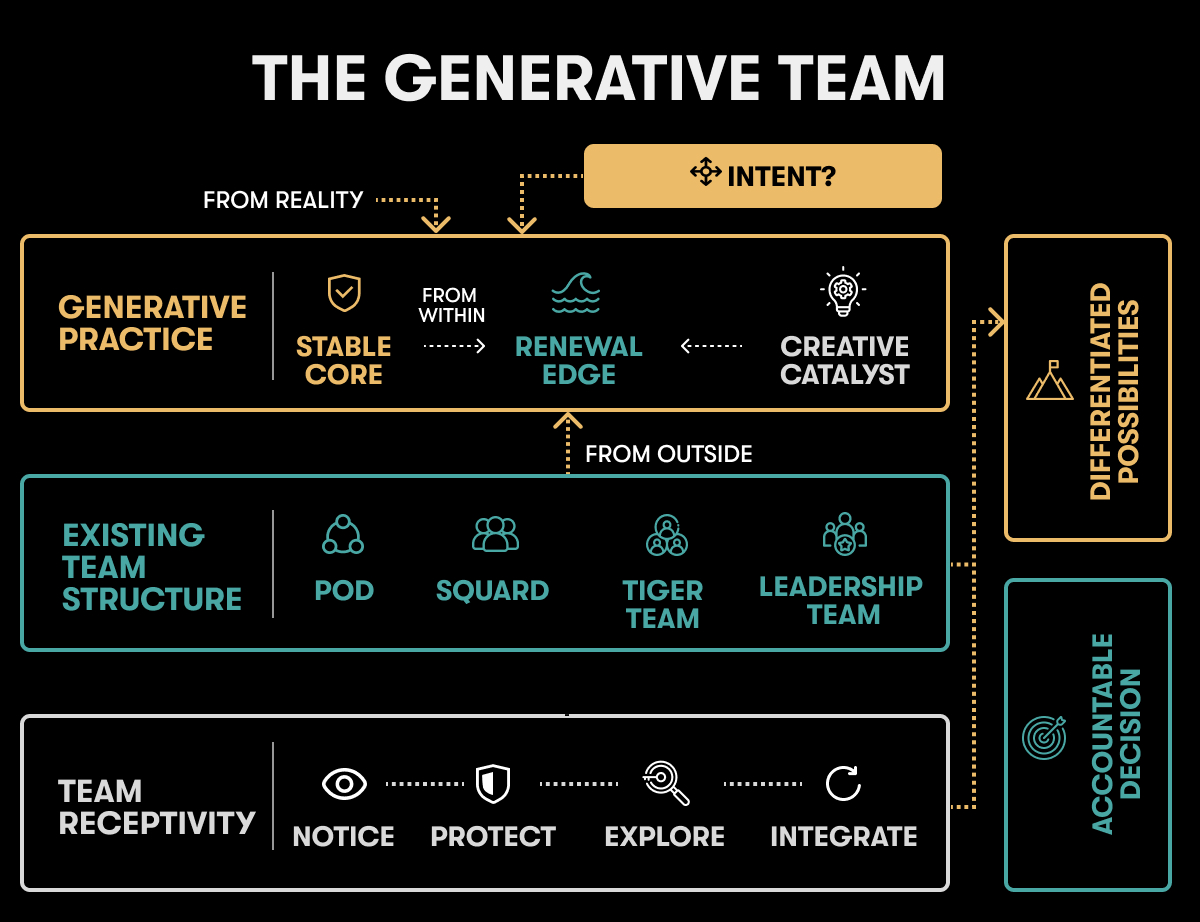
The model is simple. Intent defines the outcome. Generative practice shapes how the team thinks. Thinking Architecture shows what is present or missing. A short check-in guides the next move.
A Practice Layer, Not Another Team Type
A Generative Team is not a new structure. It is a practice layer applied to the pod, squad, tiger team, workstream, or leadership team already doing the work. The team stays intact. Its way of thinking changes.
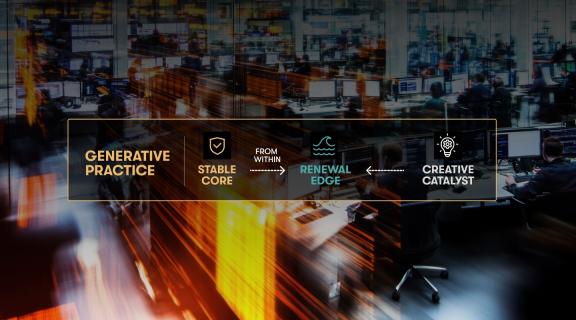
Three mechanisms shape the practice. The Stable Core carries context. The Renewal Edge activates or introduces relevant difference. The Creative Catalyst helps the team expand, choose, or reopen.
These are not three new positions. Stable Core and Renewal Edge describe how the team is composed and refreshed. Creative Catalyst is a responsibility carried by an existing team member.
The terms turn familiar practices into an operating vocabulary. Stable Core means continuity and shared context. Renewal Edge means perspective renewal across the team boundary. Creative Catalyst combines facilitation, constructive dissent, and team reflection.
Team Receptivity is the foundation: the ability to notice, protect, explore, and use unfamiliar thinking. It builds on psychological safety, which research links to discussing errors, seeking feedback, reflecting, and experimenting.[6]
Research Behind the Model
The language is new, but the practices are grounded in established team research.
| Established research stream | Supports |
|---|---|
| Team continuity and the use of shared and unshared information [1,8] | Stable Core |
| Boundary spanning, information diversity, and external communication [5,9,11] | Renewal Edge |
| Psychological safety, team learning, and information elaboration [6,9] | Team Receptivity |
| Minority influence, divergent thinking, and constructive dissent [7,10] | Creative Catalyst |
No reorganization. No new methodology. A more deliberate way for the team you already have to think and decide.
Divergence Can Come From Three Places
Divergence does not require an outsider. The Renewal Edge is the boundary through which difference is activated within the team, introduced from outside, or forced into view by reality.
- From within: a quieter member, an underused Thinking Architecture, a changed framing question, constructive dissent, or experience beyond someone’s formal role.
- From outside: a customer, frontline employee, adjacent team, specialist, partner, market signal, reviewer, or AI agent interacting with work in progress.
- From reality: a failure, missed outcome, unexpected result, or new evidence that the team’s existing assumptions cannot adequately explain.
Failure does not automatically create learning or divergence. It becomes generative when the team resists explaining it away, examines which assumption failed, and allows the evidence to reopen the frame or the decision.
Divergence and Convergence Are Both Necessary
Divergence expands the options. The team explores different frames, assumptions, and responses before choosing a path. It is not endless brainstorming. Useful divergence stays connected to the problem.
Convergence narrows the options. The team compares alternatives, combines strong elements, makes trade-offs, and commits. Without convergence, ideas never become decisions, products, or value.
The risk is premature convergence: the team narrows before exploring enough meaningful difference. Familiarity, hierarchy, time pressure, or hidden assumptions shape the decision. The team appears decisive while selecting variations of what it already knows.
Divergence creates options. Convergence creates commitment. Generative teams know when to do each.
Thinking Architecture Makes Difference Usable
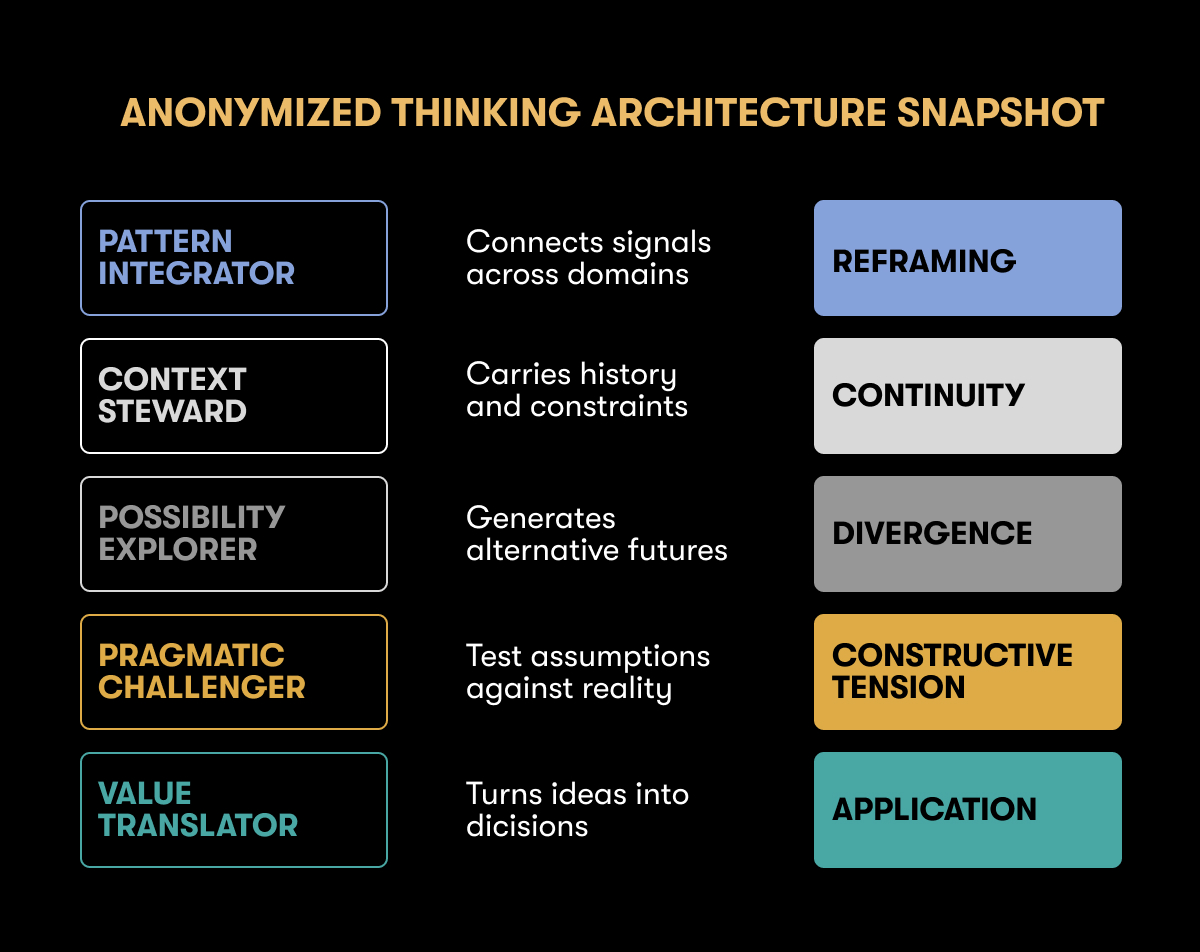
Thinking Architecture is a shared language for how people notice signals, organize complexity, generate possibilities, challenge assumptions, decide, and act. It is not a personality label. It makes thinking differences visible and usable.
Instead of asking for a “fresh perspective,” a leader can ask what thinking is missing: outside-in observation, pattern finding, possibility exploration, constructive challenge, or value translation. This turns team composition into a design decision.
From Individual Spark to Collective Expansion
When one person makes an unexpected connection, challenges the frame, or shares an unfinished idea, other people often become more creative. They connect it to a customer problem, business model, technology constraint, or another possibility. Those responses become new inputs.
This POV followed that pattern. Sharing an unfinished draft with someone outside the core work produced an idea that improved the model. They did not join the team. They briefly joined its thinking.
A creative contributor adds ideas to the room. A Creative Catalyst changes what the room can imagine.
The process becomes a feedback loop: create, share, activate, reorganize, expand, and create again.
Research supports the role of interaction. One brainstorming study linked stronger interpersonal neural coupling with higher group creativity.[4] Research also shows that time away from a problem can help break fixation.[3]
How the Generative Team Works
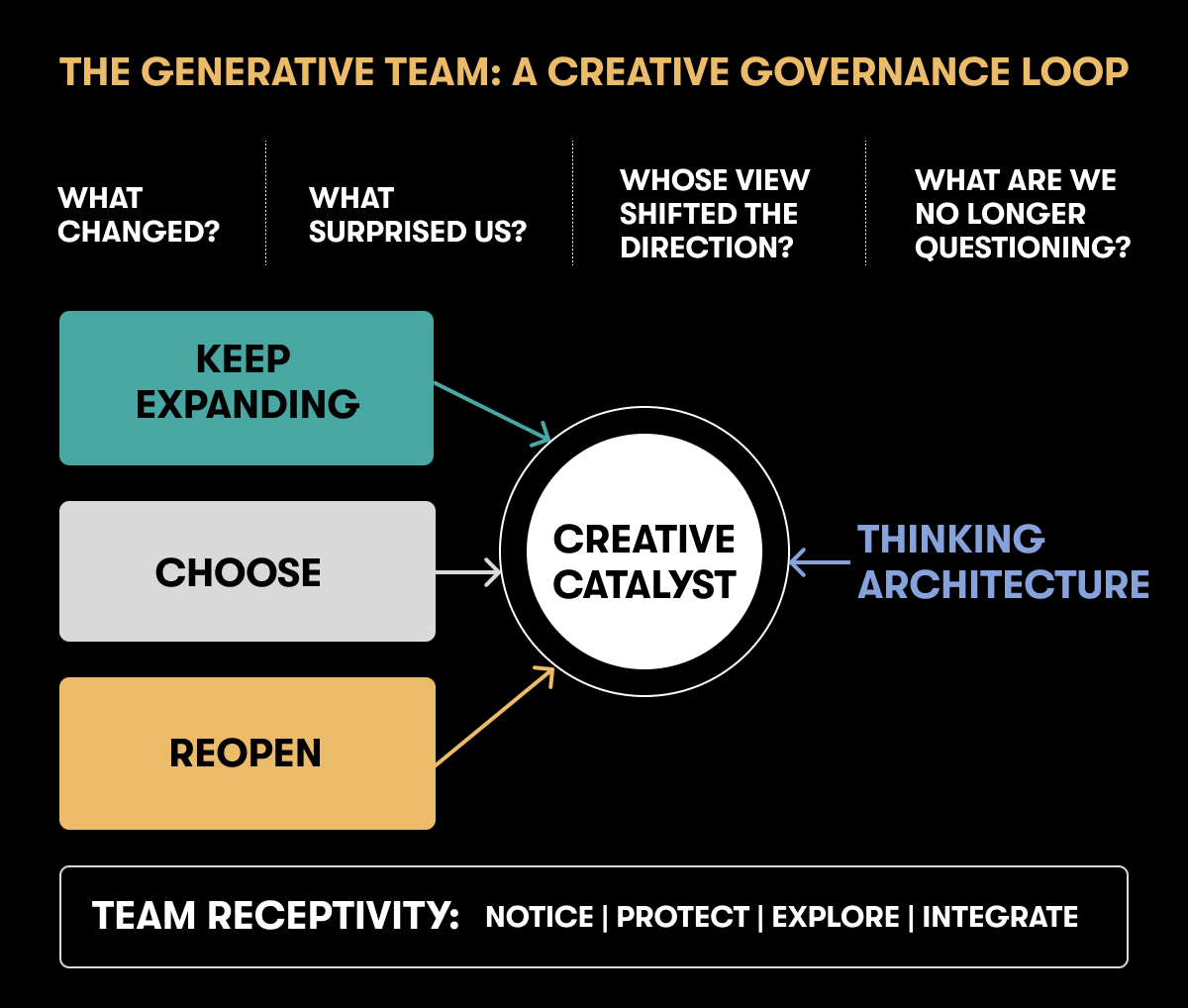
- Stable Core: retain customer knowledge, decision history, constraints, accountability, and execution rhythm while activating underused difference already inside the team.
- Renewal Edge: create a permeable boundary through which difference can emerge from within, enter from outside, or surface through failure and new evidence.
- Creative Catalyst: make the thinking mode visible, identify which source of divergence is needed, and help the team keep expanding, choose, or reopen.
Team Receptivity enables all three. Without it, the Stable Core becomes defensive, the Renewal Edge is absorbed, and the Creative Catalyst can see narrowing but cannot change it.
Difference alone is not enough. Receptivity determines whether the team turns it into value.[9]
Membership change is only one option. It can create learning but also raise coordination costs.[1] The practical answer is triggered renewal, not scheduled rotation.
The Creative Catalyst as Thinking-Mode Steward
The Creative Catalyst is not a new position or hiring requirement. It is a responsibility carried by an existing member with enough trust and independence to observe how the team is thinking.
Depending on the work, the catalyst may be a Product Lead, Strategy Lead, Design Lead, Delivery Manager, architect, facilitator, or another team member. The responsibility can rotate.
Research also shows that a designated dissenting member can increase divergent thinking and originality, but the role can be stressful.[10] Leaders must protect constructive dissent, not merely ask for it.
The catalyst does not produce all the ideas or overrule the leader. The role is to make the team’s thinking mode visible and help it expand, test, narrow, commit, or reopen. The leader still owns the decision.
In practice, the catalyst asks three questions: Are the options genuinely different? Are the alternatives and trade-offs visible? Have we preserved the rationale, rejected options, and evidence that would justify reopening the decision?
Observation provides the signal. The Creative Catalyst interprets it. The leader owns the decision.
Use Triggers, Not Rotation for Rotation’s Sake
Introduce difference when several signals appear together: ideas cluster around familiar concepts, the same people set the frame, surprise declines, challenges receive rehearsed answers, or outside evidence stops changing direction.
Match the intervention to the gap. First ask whether the needed difference already exists within the team. If not, bring in a customer, colleague, specialist, reviewer, or AI agent.[11]
If failure or new evidence contradicts the current frame, reopen the affected assumption before adding people. Change the team permanently only when the missing contribution is persistent and central to the work.
Preserve the people who carry the context. Introduce the thinking that challenges the context.
Capture Difference Before It Disappears
A newcomer does not automatically create divergence. Teams often explain the history so quickly that the newcomer learns to see the problem as they do. Capture the independent view first: What looks unusual? What assumption or question is missing?
Receptivity requires awareness. Members learn to notice their first reaction, separate unfamiliarity from quality, explore what the other person sees, and then adopt, combine, pause, or reject with a stated reason.
Notice When Alignment Becomes Habit
A study of 309 team discussions found a trade-off between developing one idea deeply and exploring broadly.[2] Leaders should watch how thinking changes, not simply count ideas.
A Simple Team Check-In
Do not start with a score. At framing, before a major decision, or when the work begins to feel familiar, take five minutes and ask the team four questions:
- What changed our understanding of the problem?
- What surprised us?
- Whose perspective changed the direction?
- What assumption are we no longer questioning?
Listen for the quality of the answers, not consensus. Specific examples suggest the team is still expanding. Treat failures, missed outcomes, and contradictory evidence as valuable answers to “What surprised us?”
Recycled examples, long pauses, or answers dominated by the same people suggest narrowing. Defensive answers suggest that difference is present but not safe enough to use.
The Creative Catalyst names the condition: “We are still expanding,” “We are ready to choose,” or “We are closing too quickly.” The label starts a conversation; it is not a rating.
What this looks like in practice
Consider a product team that has worked together for nine months. Delivery is strong, but every new idea fits the existing roadmap. During the check-in, no one can name a recent surprise. The same two people are credited with changing direction.
The catalyst does not recommend reorganizing the team. Instead, two frontline employees join the next framing session. They respond to the customer problem before seeing the current solution.
Their observations expose a hidden assumption. The team develops two different options, compares the trade-offs, and the Product Lead chooses. The catalyst records what changed the frame and what evidence would reopen the decision. Context and accountability remain intact.
Before
Strong delivery. Ideas fit the roadmap. Little recent surprise.

Intervention
Two frontline voices. Respond before seeing the current solution.
After
A hidden assumption surfaces. Two distinct options. Accountable choice.
From Observation to Governance Decision
The check-in does not decide for the team. It gives the Creative Catalyst evidence for a short governance conversation and the next move.
| What the measures show | Likely condition | Practical next move |
|---|---|---|
| Low difference and surprise | Premature convergence | Add a new frame, customer voice, challenger, or evidence. |
| High difference, low context | Unstructured divergence | Reconnect options to the decision, constraints, and value. |
| Difference present, low openness | Ideas are being filtered out | Protect challenge; explore before evaluating. |
| Distinct options and clear trade-offs | Ready to converge | Compare, combine where useful, and commit. |
| New evidence after commitment | Decision may be stale | Reopen the affected assumption, not the entire project. |
Keep governance lightweight. Use a five-minute check at framing, before a major choice, or when new evidence appears. Record four things: the current mode, what you observed, the next move, and the decision owner.
The Leadership Choice
The most valuable person in the room may not be the person with the best idea. It may be the person who helps everyone else see that a better idea is possible. But catalysts cannot compensate for a system that rejects difference.
Leaders do not need another team or specialist. They need to make the practice explicit, assign the catalyst responsibility, strengthen Team Receptivity, and introduce missing forms of thinking when signals narrow.
The accountable leader still decides. That is how creativity moves from individual talent to organizational capability without adding bureaucracy.
At the next major decision, do not ask only whether the team is aligned. Ask which alternatives were genuinely considered, whose thinking changed the frame, and what evidence would cause the team to reopen the decision.
Are we becoming better at creating, or merely faster at repeating ourselves?
The views and opinions expressed in this blog are those of the author and do not necessarily reflect the official position or perspective of Photon.
References
- Mayo, A. T., Woolley, A. W., John, L., March, C., Witchel, S., and Nowalk, A. “Coordination in Dynamic Teams: Investigating a Learning-Productivity Trade-Off.” Organization Science, 2024.
- Jiang, Y., Hu, T., Hernandez-Orallo, J., Stillwell, D., and Sun, L. “TRACE: A Corpus of Team Creative Discussions.” Proceedings of the 64th Annual Meeting of the Association for Computational Linguistics, 2026.
- Sio, U. N., and Ormerod, T. C. “Does Incubation Enhance Problem Solving? A Meta-Analytic Review.” Psychological Bulletin, 2009.
- Pick, H., Fahoum, N., Zoabi, D., and Shamay-Tsoory, S. G. “Brainstorming: Interbrain Coupling in Groups Forms the Basis of Group Creativity.” Communications Biology, 2024.
- Hülsheger, U. R., Anderson, N., and Salgado, J. F. “Team-Level Predictors of Innovation at Work: A Comprehensive Meta-Analysis Spanning Three Decades of Research.” Journal of Applied Psychology, 2009.
- Edmondson, A. C. “Psychological Safety and Learning Behavior in Work Teams.” Administrative Science Quarterly, 1999.
- Nemeth, C. J., and Kwan, J. L. “Minority Influence, Divergent Thinking and Detection of Correct Solutions.” Journal of Applied Social Psychology, 1987.
- Stasser, G., and Titus, W. “Pooling of Unshared Information in Group Decision Making: Biased Information Sampling During Discussion.” Journal of Personality and Social Psychology, 1985.
- Homan, A. C., van Knippenberg, D., van Kleef, G. A., and De Dreu, C. K. W. “Bridging Faultlines by Valuing Diversity: Diversity Beliefs, Information Elaboration, and Performance in Diverse Work Groups.” Journal of Applied Psychology, 2007.
- Van Dyne, L., and Saavedra, R. “A Naturalistic Minority Influence Experiment: Effects on Divergent Thinking, Conflict and Originality in Work-Groups.” British Journal of Social Psychology, 1996.
- Ancona, D. G., and Caldwell, D. F. “Bridging the Boundary: External Activity and Performance in Organizational Teams.” Administrative Science Quarterly, 1992.