
Preserve
What the business still needs: data, business rules, evidence, controls, operational knowledge.
HOME | insights | OFFICIAL POV
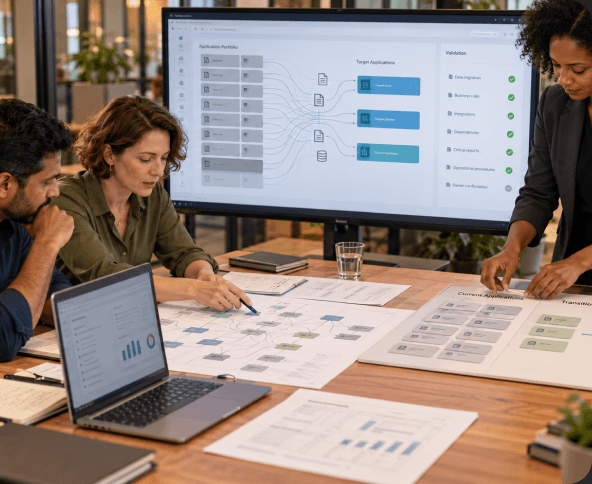
SaaS retirement using AI is the controlled removal or consolidation of a legacy application while preserving the data, business rules, integrations, controls, evidence and operational knowledge the business still needs. It is not a license-cancellation exercise, and it is not simply a migration from one vendor to another.
The difficult work is discovering what the old system actually does, separating valuable capability from accumulated workarounds, moving data safely, proving downstream processes still work and making sure knowledge does not disappear when the old platform is switched off.
AI changes the economics because much of retirement is analysis-intensive: reading code and configuration, tracing dependencies, classifying data, documenting process behavior, generating test cases and synthesizing years of operational knowledge. Gartner’s 2026 enterprise-application research explicitly connects AI-enabled modernization with portfolio rationalization, including application consolidation and decommissioning. [1]
But AI does not decide what the enterprise should preserve. That remains a process, architecture, risk and value decision.
Photon Point of View
“Retire the operating debt, not just the software license. A retirement program succeeds only when the old system can disappear without taking required business capability with it.”
Retire the debt
What the business still needs: data, business rules, evidence, controls, operational knowledge.
What should work differently: legacy handoffs, manual workarounds, duplicated approvals, brittle process logic.
What no longer earns its place: unused features, duplicate capability, redundant interfaces, avoidable operating cost.
START WITH CAPABILITY.
Replacement software comes later.
Figure 1
SaaS retirement starts by separating what must be preserved, what should be redesigned and what can finally be retired.
01
A retirement starts with a capability inventory, not a replacement-product shortlist. Teams need to understand who uses the application, which processes depend on it, what data it owns, which systems call it, which controls are embedded in it and where custom logic has accumulated. Only then can the enterprise decide what should be preserved, redesigned or removed.
This is an AI Strategy decision before it becomes an engineering decision. Photon’s process-reimagination approach challenges whether the current workflow should continue in its existing form before automation or migration begins. Reproducing every legacy handoff in a new platform may reduce one license bill while preserving the operating debt that made the old environment expensive.
In practice, the application is rarely the whole system. Important business logic often escapes into integration scripts, admin settings, spreadsheets, support tickets and the institutional knowledge of a few experienced people. A retirement plan that inventories only the application will miss part of the operating model.
02
AI is most useful when it accelerates discovery and analysis. Gartner’s 2026 research on AI-augmented modernization tools identifies capabilities such as application-portfolio analysis, business-rule extraction, dependency mapping, intelligent documentation, validation and testing. [2] Those are exactly the areas where retirement programs can spend large amounts of expert time before engineering even begins.
Photon applies AI to four labor-intensive parts of modernization. Data extraction identifies and classifies information that must be retained, transformed, archived or discarded, while deterministic reconciliation confirms that required records arrive intact. Process mapping uses configuration, documentation, interface definitions and operating history to expose the real workflow rather than the version described in an old process document.
Automated testing is the third area. AI can generate regression scenarios, expand coverage, compare old and new behavior and focus engineering attention on exceptions. In a Fortune 100 financial-services engagement, Photon’s GenAI-based testing approach reduced testing effort by 20%, providing a measured example of the efficiency available when AI is embedded across the testing lifecycle. [3]
Knowledge transfer is the fourth. Retirement often concentrates risk in a small number of people who understand undocumented rules, workarounds and support history. AI can synthesize runbooks, tickets, code comments and technical documentation into a working knowledge base, while subject-matter experts validate the business rules that must survive the transition.
These capabilities sit inside AI Engineering. Architecture, data movement, integration, testing, observability and cutover still require production-grade engineering. AI accelerates the work around them; it does not remove the need for controls or human accountability.
Where AI removes work
Inventory artifacts, configuration, users, data and hidden dependencies.
Reconstruct process paths, business rules, interfaces and exceptions.
Generate regression scenarios, compare behavior and focus engineers on exceptions.
Synthesize runbooks, tickets and documentation into a validated knowledge base.
AI ACCELERATES THE ANALYSIS.
Humans still decide what survives.
Figure 2
AI can compress four labor-intensive retirement workstreams while leaving preservation and cutover decisions with accountable teams.
03
Retirement economics are easy to overstate. A program does not realize the full benefit of removing an application if the old license, infrastructure, support model, integration estate and parallel-run environment continue indefinitely.
That is why the business case should include both the transition cost and the run cost that can actually be removed. Time improves when discovery, documentation and regression testing require less manual effort. Cost improves when licenses, support burden and duplicate infrastructure disappear. Data integrity improves when migration is reconciled against agreed business records, retention rules and access controls. Team disruption falls when knowledge capture happens before key experts are pulled into cutover emergencies.
A migration that leaves the legacy platform alive as a permanent safety net is not retirement. It is an additional operating layer. The value case should therefore be measured against the moment the enterprise can decommission the old system, not the date the new environment first goes live.
04
The final shutdown decision should be evidence-based. The enterprise should be able to show that critical data is reconciled, required workflows complete correctly, integrations have defined failure and recovery paths, users can operate the target process, controls still work and the economics include the cost of transition itself.
The outcome metric should remain tied to the reason for retirement: lower run cost, less manual effort, faster change, lower error rates, lower support demand or a simpler application estate. The strongest proof is not that migration completed. It is that the legacy system can be switched off and the required business capability continues with less operating debt than before.
The retirement gate
Required records arrive intact against the agreed business rules.
The target process finishes the job the old system performed.
Downstream systems can detect and recover a failed handoff.
Oversight does not disappear with the license.
The people who do the work can complete it without the old platform.
The case is measured when the old system is actually off.
Figure 3
The retirement gate: evidence required before the old system can be decommissioned.
05
Photon’s model is deliberately end to end. AI Strategy determines what capability should survive, what should be redesigned and what no longer earns its place. AI Engineering maps, rebuilds, migrates, integrates and tests the target state. Client Outcomes defines the evidence required to approve decommissioning and measures whether the expected value is actually realized.
The objective is not to replace one large SaaS footprint with another. It is to remove technology that no longer earns its place in the operating model while preserving the capability, control and institutional knowledge the enterprise still needs.
Explore Photon AI Engineering or contact Photon to discuss an AI-assisted SaaS retirement or modernization program.
Primary and supporting sources used to validate this POV.
Accessed October 1, 2026.
AI-enabled continuous modernization and portfolio rationalization, including consolidation and decommissioning.
Includes application-portfolio analysis, business logic extraction, dependency mapping, intelligent documentation, validation and testing.
Photon case study reporting a 20% reduction in testing effort.
Photon migration framework includes retirement as an explicit modernization path.
Photon framework for connecting AI initiatives to value and adoption.