

Agentic AI Systems
Multi-agent orchestration built on the Universal Agent Harness™ — super-agent and sub-agent architectures that automate multi-step enterprise workflows end to end.
Home | Consulting | ENGINEERING
Engineering is the technical delivery practice that turns AI strategy into running systems. With 8,500+ engineers embedded directly in client environments, Photon builds and deploys agentic AI programs using the same Lean Lab delivery model that has cut time-to-market by up to 3x on traditional software — small, co-located, fully-empowered pods, now building and operating agentic systems on PHTN.ai.
Talk to Our Team
We engineer intelligent agents, generative AI applications, and machine learning solutions that automate complex workflows and bring enterprise AI into production.
Multi-agent orchestration built on the Universal Agent Harness™ — super-agent and sub-agent architectures that automate multi-step enterprise workflows end to end.

LLM integration and enterprise generative AI product development — from prototype to production-grade application.

Model development, MLOps, and production deployment — AI as the core engineering discipline, from training through production monitoring.
We bring AI into enterprise operations through intelligent agents, generative applications, and machine learning—built to automate workflows, improve decisions, and scale.

Cloud architecture, migration, and managed operations across Azure, AWS, and Google Cloud — the infrastructure foundation every Engineering deployment runs on top of.

The omnichannel commerce backbone behind Photon's retail and CPG engagements — commerce-as-a-service platforms, API design, and microservices architecture that let systems scale and deploy independently.

The data foundation every agent and analytics program depends on — architecture, integration, and pipeline work that determines whether an AI deployment can actually operate reliably at scale.
how we deliver
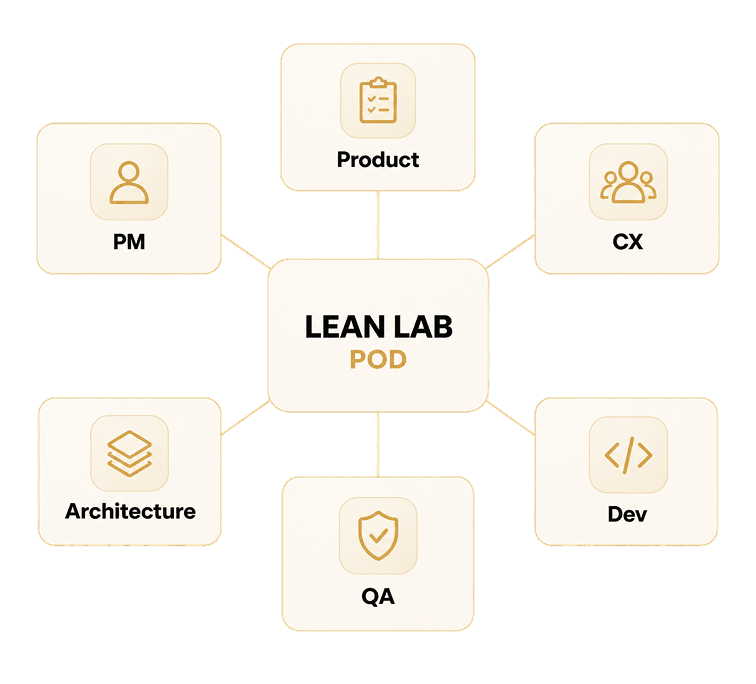
Photon's engineering delivery model puts small, fully-empowered, co-located pods against a single feature or component — Product, PM, CX, Architecture, Dev, and QA in one room, avoiding the handoffs that slow larger programs down. Squads scale from a 4-person "Mini" pod to a 14-person "Extra Large" pod depending on scope, with built-in quality and continuous-delivery infrastructure that lets teams regress and release code multiple times a day.
Photon's own internal SDLC Agent is a working example of the agentic systems this practice builds: one super-agent orchestrating nine sub-agents that turn raw inputs — meeting notes, transcripts, emails, decks — directly into structured PRDs, epics, user stories, acceptance criteria, and test cases, with a one-click sync to Jira and auto-generated UI prompts for rapid prototyping.
Reduction in requirements-to-delivery prep time verses manual process
PRD, story, and test-case creation time, before vs. after
Specialist sub-agents ⎯ structuring, decomposition, Gherkin, QA governance, and more
Jira sync for epics, user stories, and test cases
We track clear, outcome based metrics to ensure our pods delivery real business value.
KPI
What We Measure
Time to Market
Meaningful reduction versus current release schedules for a new feature
Defects in Production
Escape defect rate versus historical production releases
Productivity / Throughput
Story points and estimation models measured against a pre-engagement baseline
Employee Engagement
Before-and-after survey capturing team morale and satisfaction
Business Objectives
Defined, projected business impact — measured whether or not it is met